

Check Real VMware 2V0-12.24 Exam Question for Free (2025)
Get Ready to Boost your Prepare for your 2V0-12.24 Exam with 109 Questions
NEW QUESTION # 17
Place the following steps in the correct order to resolve a disk failure in vSAN:
A) Identify the failed disk using vSAN health checks
B) Replace the failed disk
C) Rebuild the disk group and re-sync the data
D) Verify the disk status and ensure it is detected by the system
Response:
- A. B → A → D → C
- B. D → B → C → A
- C. C → D → A → B
- D. A → D → B → C
Answer: D
NEW QUESTION # 18
Which is the appropriate first action to take to resolve dropped network packets on an ESXi host?
- A. Migrate VMs to another data store
- B. Check physical network switch configuration
- C. Increase the CPU and memory allocation for VMs
- D. Enable Storage I/O Control
Answer: B
Explanation:
Dropped network packets are often caused by misconfigurations or issues at the physical network layer. Checking the physical network switch configuration is the first step to ensure that the network settings, such as VLANs, uplinks, and port configurations, are correctly set up. This ensures proper connectivity and traffic flow for the ESXi host and the VMs.
NEW QUESTION # 19
An administrator needs to configure an ESXi host and create a host profile to ensure consistent configuration across multiple hosts in a cluster.
Which three steps are necessary to achieve this? (Choose three.)
- A. Remediate the non-compliant hosts to ensure they match the host profile.
- B. Extract the host profile from the configured reference host.
- C. Manually configure each host to match the reference host settings.
- D. Apply the host profile to all hosts in the cluster.
- E. Configure the desired settings on a reference ESXi host.
Answer: A,B,E
Explanation:
First, configure the desired settings on a reference ESXi host. This host will be used as the template for creating a consistent configuration across the cluster.
After configuring the reference host, extract the host profile from it. This captures the configuration of the reference host as a host profile.
Remediation is necessary to ensure that other hosts in the cluster align with the reference host's configuration. The host profile can be applied, and remediation will correct any non-compliant settings on other hosts.
NEW QUESTION # 20
An administrator is tasked with deploying a new application that requires both virtual machines and containers.
Which two components of VMware Cloud Foundation would be utilized to provide a unified platform for managing these workloads? (Choose two.)
- A. IaaS Control Plane
- B. HCX
- C. NSX
- D. Aria Operations
- E. Aria Suite Lifecycle
Answer: C,D
Explanation:
Aria Operations: Aria Operations (formerly vRealize Operations) provides a unified platform for managing both virtual machines (VMs) and containers, offering monitoring, analytics, and performance management for the entire environment.
NSX: NSX provides network virtualization and security, which can be used to manage network traffic for both VMs and containers, offering a consistent networking model for both workloads.
NEW QUESTION # 21
An organization has experienced performance issues and requires a detailed analysis of infrastructure performance, capacity, utilization, and compliance using VMware Aria components.
What three steps should be followed to generate and analyze these reports? (Choose three.)
- A. Use Aria Operations for Logs to correlate log data with performance
- B. Export the reports for further analysis and compliance verification
- C. Access Aria Operations and navigate to the Reports section
- D. Run predefined reports on capacity and utilization
- E. Create custom dashboards to monitor performance metrics
Answer: A,D,E
Explanation:
Creating custom dashboards in Aria Operations allows administrators to visualize and monitor performance metrics specific to the organization's needs, making it easier to analyze the infrastructure.
Using Aria Operations for Logs helps correlate log data with performance issues, enabling a deeper analysis and understanding of the root causes of performance problems.
Running predefined reports on capacity and utilization provides valuable insights into how resources are being consumed, helping identify areas that need optimization or adjustment.
NEW QUESTION # 22
A disk failure has occurred in a vSAN cluster.
What four steps should be taken to recover from this disk failure? (Choose four.)
- A. Disable disk group encryption
- B. Perform a full resync of the vSAN objects
- C. Rebuild the affected disk group
- D. Replace the failed disk with a new one
- E. Use the vSohere Client to check the vSAN Health Service
- F. Ensure the new disk is claimed by the vSAN cluster
Answer: C,D,E,F
Explanation:
Checking the vSAN Health Service in the vSphere Client is the first step in diagnosing the issue and verifying the status of the vSAN components after the disk failure.
Rebuilding the affected disk group is necessary to ensure that data is re-optimized and replicated in accordance with the vSAN policy.
Replacing the failed disk with a new one ensures that the storage capacity is restored.
Ensuring that the new disk is claimed by the vSAN cluster is important to ensure that it is recognized and integrated into the vSAN disk group.
NEW QUESTION # 23
A specific VM is unable to communicate with other VMs in the same network. An administrator needs to identify and resolve the network connectivity issue.
What three steps should the administrator follow? (Choose three.)
- A. Restart the VM to reset its network connections
- B. Use the ESXi command line to check the status of the VM Kernel adapter
- C. Check the network adapter settings in vCenter Server
- D. Verify the port group settings and VLAN configuration
- E. Verify that the VM is connected to the correct port group
Answer: C,D,E
Explanation:
Port group settings and VLAN configurations need to be correct for VMs to communicate with each other on the same network. Ensuring they are properly configured is essential.
It's important to check that the VM is connected to the correct port group that matches the network configuration of the other VMs.
The network adapter settings in vCenter Server should be reviewed to ensure there are no misconfigurations that could prevent network communication.
NEW QUESTION # 24
An administrator needs to ensure that network traffic is protected from interception and tampering during VM migration activities. What feature or setting should the administrator enable to achieve this?
- A. vSphere DRS
- B. vSphere HA
- C. vSphere Virtual Machine Encryption
- D. Encrypted vSphere vMotion
Answer: D
Explanation:
Encrypted vSphere vMotion ensures that network traffic is protected from interception and tampering during VM migration activities by encrypting the vMotion traffic. This feature secures the transfer of virtual machines across hosts in the vSphere environment.
NEW QUESTION # 25
Which VMware vSphere feature provides the ability to define and apply datastore capabilities to ensure virtual machines meet specific performance and availability requirements?
- A. Performance Service
- B. Storage Policies
- C. Storage Policy Components
- D. Host Profiles
Answer: B
Explanation:
Storage Policies in VMware vSphere allow administrators to define and apply specific storage requirements for virtual machines, ensuring they meet desired performance and availability standards. These policies enable the alignment of VM storage needs with the capabilities of the underlying datastores.
NEW QUESTION # 26
When configuring a new port group on a Virtual Distributed Switch (VDS), what is the purpose of setting a VLAN ID?
- A. To enable load balancing across multiple uplinks.
- B. To segment and isolate network traffic.
- C. To manage storage replication settings
- D. To automate the creation of VMs within the port group.
Answer: B
Explanation:
Setting a VLAN ID on a port group on a Virtual Distributed Switch (VDS) allows for network segmentation by tagging traffic with the appropriate VLAN ID. This enables isolation of network traffic between different VLANs, ensuring that communication is restricted to specific segments of the network as required.
NEW QUESTION # 27
Which vSphere component is essential for providing persistent storage to Kubernetes workloads deployed on IaaS Control Plane?
- A. Pod Service
- B. Container Image Virtual Disks
- C. Control Plane Storage Policy
Answer: A
Explanation:
The vSphere Pod Service is essential for providing persistent storage to Kubernetes workloads deployed on IaaS Control Plane (formerly vSphere with Tanzu). It enables the integration of Kubernetes with vSphere, allowing the creation of persistent volumes and the management of storage resources for Kubernetes workloads, ensuring that they can utilize vSphere's storage capabilities like vSAN.
NEW QUESTION # 28
An administrator needs to add a new cluster to an existing VI workload domain. The existing cluster in the domain is using NFS as its principal storage.
Which principal storage options are available for the new cluster?
- A. vSAN, NFS, or VMFS on Fibre Channel
- B. NFS only
- C. NFS or vSAN
- D. vSAN, NFS, VMFS on Fibre Channel, or vVols
Answer: C
Explanation:
In a VMware Cloud Foundation (VCF) environment, when adding a new cluster to an existing VI workload domain, the new cluster must use the same principal storage as the existing cluster. Since the existing cluster is using NFS, the available storage options for the new cluster would be NFS or vSAN, depending on the configuration.
NEW QUESTION # 29
Match each troubleshooting task with its relevant procedure or tool.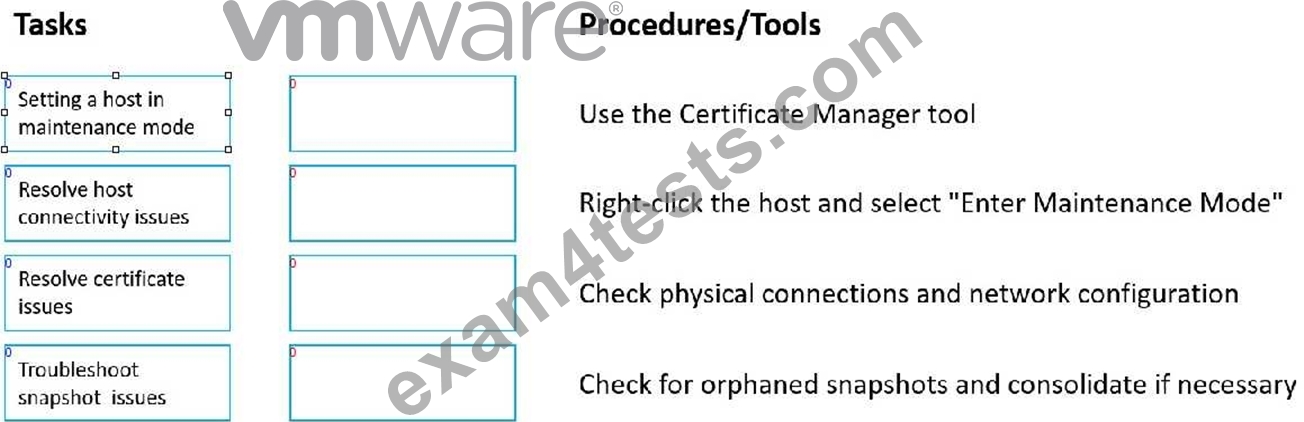
Answer:
Explanation: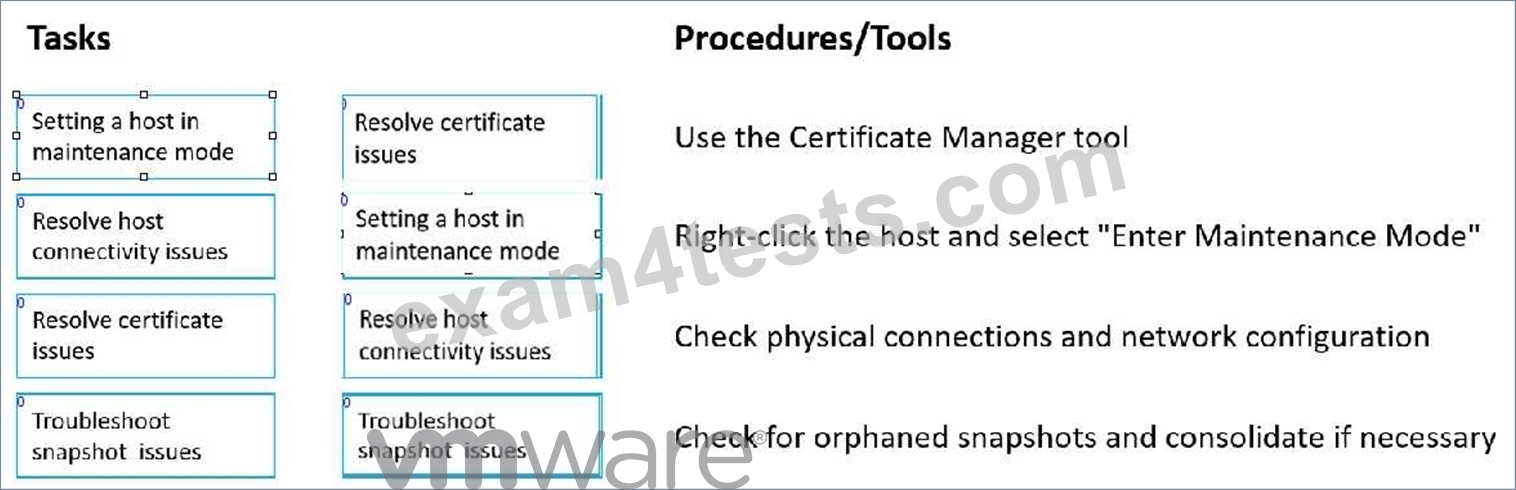
NEW QUESTION # 30
An administrator has a requirement to share the contents of a Content Library across multiple vCenter instances.
What steps should the administrator perform to meet this requirement?
- A. Create a Subscribed content library on a single vCenter instance and perform a synchronization
- B. Create a Local content library on each vCenter instance and perform a synchronization
- C. Create a Subscribed content library on each vCenter instance and enable publishing
- D. Create a Local content library on a single vCenter instance and enable publishing
Answer: D
Explanation:
To share the contents of a Content Library across multiple vCenter instances, you need to create a Local content library on one vCenter instance and enable publishing. This allows the library to be accessible by other vCenter instances, where they can subscribe to it, ensuring the content is shared.
NEW QUESTION # 31
What is the impact of consolidating snapshots on a virtual machine?
- A. It temporarily increases the available disk space consumption on the datastore while merging data.
- B. It changes the VM's hardware compatibility settings.
- C. It reverts the VM to the state of the first snapshot taken.
- D. It disconnects the VM from the network temporarily.
Answer: A
Explanation:
When consolidating snapshots, the data from the snapshot files is merged back into the original virtual disk. This process temporarily increases the disk space usage on the datastore because of the additional space required to merge the snapshot data into the primary disk.
NEW QUESTION # 32
What two components are essential to resolve lifecycle management issues in vSphere?
(Select two)
Response:
- A. vSphere Lifecycle Manager (vLCM)
- B. ESXi version compatibility
- C. VMware Tools
- D. vCenter Server Appliance
Answer: A,B
NEW QUESTION # 33
An administrator logged into NSX Manager to view host details. The administrator noticed that the "Tunnel" status for the ESXi hosts, in the VI workload domain, is showing down.
What is a possible reason the ESXi host tunnels are showing down in NSX?
- A. The IGMP has been disabled on the network.
- B. The host TEP IP addresses are being dynamically assigned through DHCP instead of being statically assigned.
- C. The MTU setting for the host TEPs has been set to 1500.
- D. The overlay traffic is being blocked by the gateway firewall.
Answer: C
Explanation:
The "Tunnel" status in NSX indicates the status of the VXLAN tunnels used for communication between ESXi hosts. If the MTU setting for the host Tunnel Endpoint (TEP) is incorrectly set to 1500, this can cause issues with VXLAN encapsulation, as VXLAN packets typically require an MTU of at least 1600 bytes to function correctly. Setting the MTU too low can cause packet drops and result in the tunnel status being down.
NEW QUESTION # 34
While deploying the first VI workload domain in a VMware Cloud Foundation solution, which two steps will always be performed by SDDC Manager? (Choose two.)
- A. Deploy a new NSX Manaqer instance for the VI workload domain.
- B. Confiqure vSAN for the VI workload domain's storaqe needs.
- C. Deploy an NSX Edqe cluster and confiqure BGP routinq on the TO Gateway.
- D. Deploy and confiqure a newvCenter Server instance for the VI workload domain.
- E. Connect a newvCenter Server instance to the Application Virtual Network.
Answer: A,D
Explanation:
SDDC Manager automatically deploys and configures a new vCenter Server instance as part of the deployment of the VI workload domain.
SDDC Manager also handles the deployment of a new NSX Manager instance to provide network virtualization services for the VI workload domain.
NEW QUESTION # 35
An administrator is deploying an NSX Edge cluster from SDDC Manager. The administrator plans to configure the Border Gateway Protocol (BGP) to enable dynamic routing with the upstream physical networking.
Which three values must be provided when configuring BGP? (Choose three.)
- A. BGP Password
- B. BGP Route Topology
- C. BGP Router ID
- D. BGP Autonomous System Number (ASN)
- E. BGP Peer IP
Answer: C,D,E
Explanation:
The BGP Autonomous System Number (ASN) is a unique identifier that must be configured for BGP to define the routing domain.
The BGP Router ID is used to uniquely identify the BGP router in the network.
The BGP Peer IP is required to establish a BGP peering relationship with an upstream router or another BGP-enabled device.
NEW QUESTION # 36
......
Use Free 2V0-12.24 Exam Questions that Stimulates Actual EXAM : https://braindumps.exam4tests.com/2V0-12.24-pdf-braindumps.html