

Exam4Tests CAPM Exam Questions | Real CAPM Practice Dumps
Verified CAPM Exam Dumps Q&As - Provide CAPM with Correct Answers
PMI CAPM certification exam consists of 150 multiple-choice questions and lasts for three hours. CAPM exam covers topics such as project integration management, project scope management, project time management, project cost management, project quality management, project resource management, project communication management, project risk management, and project procurement management.
To earn the PMI CAPM certification, candidates must pass a rigorous exam that tests their understanding of project management principles and practices. CAPM exam covers a wide range of topics including project integration, scope management, time management, cost management, quality management, human resource management, communication management, risk management, and procurement management. CAPM exam is designed to test not only the candidate's knowledge of project management but also their ability to apply that knowledge in real-world scenarios.
NEW QUESTION # 187
A tool and technique used during the Collect Requirements process is:
- A. alternatives identification.
- B. product analysis.
- C. expert judgment.
- D. prototypes.
Answer: D
Explanation:
Section: Volume E
Explanation:
Process: 5.2 Collect Requirements
Definition: The process of determining, documenting, and managing stakeholder needs and requirements to meet project objectives.
Key Benefit: The key benefit of this process is that it provides the basis for defining and managing the project scope including product scope.
Inputs
1. Scope management plan
2. Requirements management plan
3. Stakeholder management plan
4. Project charter
5. Stakeholder register
Tools & Techniques
1. Interviews
2. Focus groups
3. Facilitated workshops
4. Group creativity techniques
5. Group decision-making techniques
6. Questionnaires and surveys
7. Observations
8. Prototypes
9. Benchmarking
10.Context diagrams
11.Document analysis
Outputs
1. Requirements documentation
2. Requirements traceability matrix
NEW QUESTION # 188
Which of the following is an output of the Distribute Information process?
- A. Project calendar
- B. Communications management plan
- C. Project document updates
- D. Organizational process assets updates
Answer: D
NEW QUESTION # 189
The project manager is working in the processes of Project Resource Management.
Which process is the project manager developing if they are using parametric estimation?
- A. Estimate Activity Resources
- B. Estimate Costs
- C. Plan Resource Management
- D. Acquire Resources
Answer: C
NEW QUESTION # 190
Which tasks should a project manager perform in order to manage the project schedule effectively?
- A. Plan Schedule Management, Define Activities, Sequence Activities, Estimate Activity Durations, Develop Schedule, Control Schedule
- B. Plan Schedule Management, Define Activities, Sequence Activities, Estimate Activity Durations, Estimate Cost of Activities, Develop Schedule
- C. Define Activities, Sequence Activities, Estimate Activity Durations, Define Quality of Activities, Estimate Cost of Activities, Develop Schedule
- D. Plan Schedule Management, Define Activities, Sequence Activities, Estimate Activity Durations, Define Quality of Activities, Develop Schedule
Answer: A
NEW QUESTION # 191
Which of the following events would result in a baseline update?
- A. A customer has approved a change request broadening the project scope and increasing the budget.
- B. A project is behind schedule and the project manager wants the baseline to reflect estimated actual completion.
- C. One of the risks identified in the risk management plan occurs, resulting in a schedule delay.
- D. One of the key project team resources has left the team and no replacement is available.
Answer: A
Explanation:
Explanation/Reference:
Explanation:
5.6.3.3 Project Management Plan Updates
Project management plan updates may include, but are not limited to:
* Scope Baseline Updates. If the approved change requests have an effect on the project scope, then the scope statement, the WBS, and the WBS dictionary are revised and reissued to reflect the approved changes through Perform Integrated Change Control process.
* Other Baseline Updates. If the approved change requests have an effect on the project besides the project scope, then the corresponding cost baseline and schedule baselines are revised and reissued to reflect the approved changes.
NEW QUESTION # 192
A project manager is estimating project activities using an algorithm to calculate costs or durations.
What is this technique called?
- A. Three-point estimating
- B. Parametric estimating
- C. Analogous estimating
- D. Bottom-up estimating
Answer: B
NEW QUESTION # 193
An output of the Create WBS process is:
- A. Requirements traceability matrix.
- B. Scope baseline.
- C. Project scope statement.
- D. Organizational process assets.
Answer: B
NEW QUESTION # 194
A project team member agrees to change a project deliverable after a conversation with an external stakeholder. It is later discovered that the change has had an adverse effect on another deliverable. This could have been avoided if the project team had implemented:
- A. Integrated change control.
- B. A stakeholder management plan.
- C. Quality assurance.
- D. Project team building.
Answer: A
NEW QUESTION # 195
Match the project manager's sphere of influence with the associated primary role.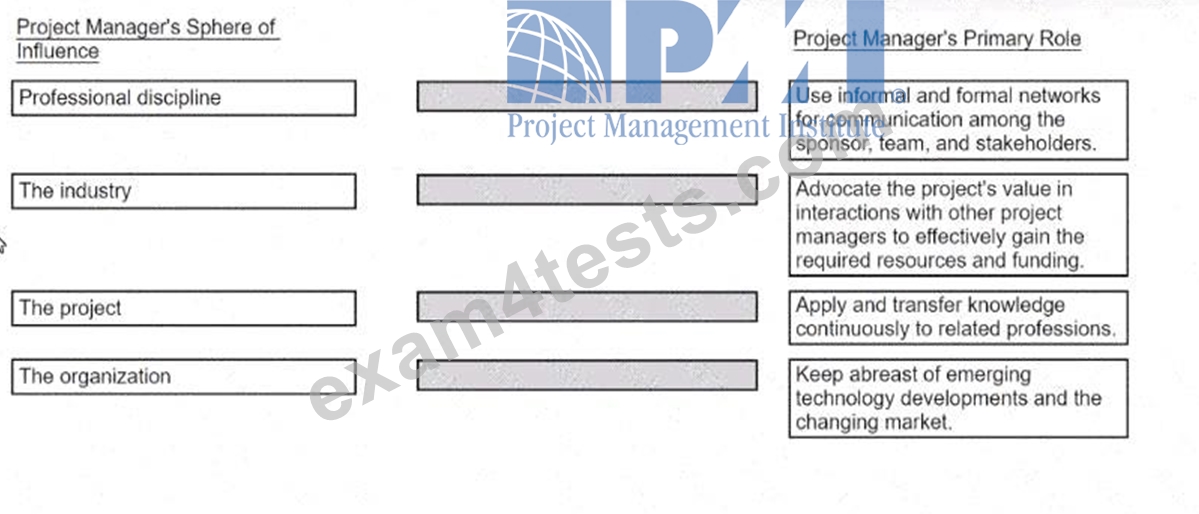
Answer:
Explanation: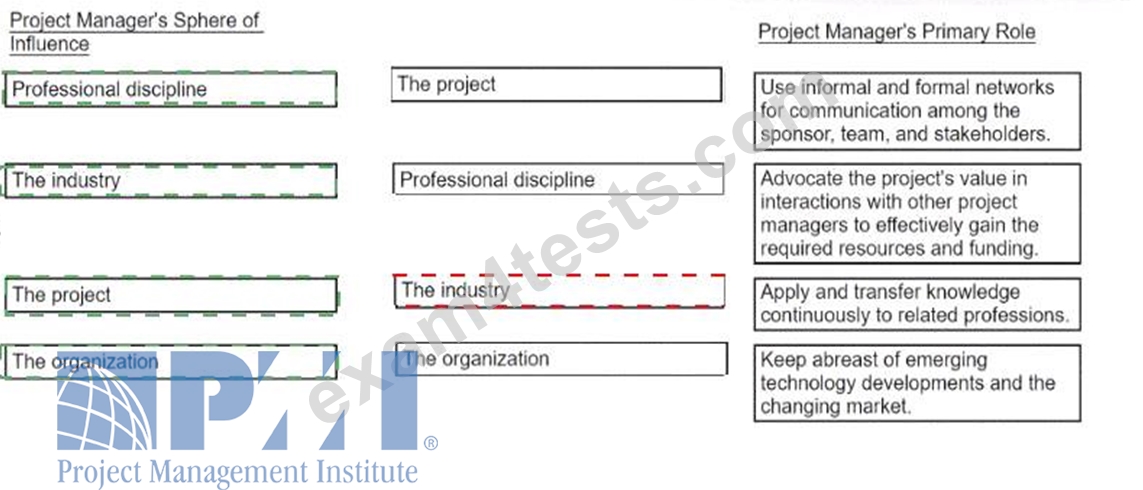
NEW QUESTION # 196
The following chart contains information about the tasks in a project.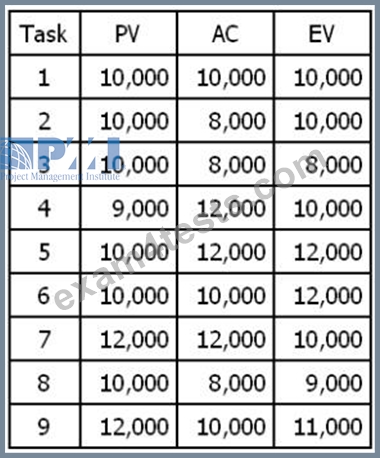
Based on the chart, what is the schedule performance index (5PI) for Task 4?
- A. 0.83
- B. 1.33
- C. 0.9
- D. 1.11
Answer: D
NEW QUESTION # 197
Which is an output from Distribute Information?
- A. Earned value analysis
- B. Trend analysis
- C. Performance reviews
- D. Project records
Answer: D
Explanation:
Section: Volume D
NEW QUESTION # 198
When a control chart is used to monitor performance of a process, which of the following will be set by the project manager and the appropriate stakeholders to reflect the point(s) at which corrective action will be taken to prevent exceeding the specification limits?
- A. Data points
- B. Upper and lower specification limits
- C. Upper and lower control limits
- D. Process mean
Answer: C
Explanation:
Section: Volume E
NEW QUESTION # 199
An input to the Plan Procurement Management process is:
- A. A stakeholder register.
- B. Source selection criteria.
- C. A records management system.
- D. Market research.
Answer: A
Explanation:
Section: Volume A
Explanation:
5.2.1.5 Stakeholder Register
Described in Section 13.1.3.1. The stakeholder register is used to identify stakeholders who can provide information on the requirements. The stakeholder register also captures major requirements and main expectations stakeholders may have for the project.
13.1.3.1 Stakeholder Register
The main output of the Identify Stakeholders process is the stakeholder register. This contains all details related to the identified stakeholders including, but not limited to:
Identification information. Name, organizational position, location, role in the project, contact information;
Assessment information. Major requirements, main expectations, potential influence in the project, phase
in the life cycle with the most interest; and
Stakeholder classification. Internal/external, supporter/neutral/resistor, etc.
The stakeholder register should be consulted and updated on a regular basis, as stakeholders may change- or new ones identified-throughout the life cycle of the project.
Process: 12.1 Plan Procurement Management
Definition: The process of documenting project procurement decisions, specifying the approach, and identifying potential sellers.
Key Benefit: The key benefit of this process is that it determines whether to acquire outside support, and if so, what to acquire, how to acquire it, how much is needed, and when to acquire it.
Inputs
1. Project management plan
2. Requirements documentation
3. Risk register
4. Activity resource requirements
5. Project schedule
6. Activity cost estimates
7. Stakeholder register
8. Enterprise environmental factors
9. Organizational process assets
Tools & Techniques
1. Make-or-buy analysis
2. Expert judgment
3. Market research
4. Meetings
Outputs
1. Procurement management plan
2. Procurement statement of work
3. Procurement documents
4. Source selection criteria
5. Make-or-buy decisions
6. Change requests
7. Project documents updates
NEW QUESTION # 200
A project manager needs to tailor the Project Cost Management process. Which considerations should the project manager apply?
- A. Stakeholder's relationships
- B. Knowledge management
- C. Diversity background
- D. Technical expertise
Answer: B
Explanation:
Section: Volume E
Explanation
NEW QUESTION # 201
What is the function of a Project Management Office (PMO)?
- A. To administer performance reviews for the project manager and the project team members and to handle any personnel and payroll issues.
- B. To focus on the coordinated planning, prioritization, and execution of projects and subprojects that are tied to the parent organizations or the client's overall business objectives.
- C. To focus on the specified project objectives and to manage the scope, schedule, cost, and quality of the work packages.
- D. To coordinate and manage the procurement of projects relevant to the parent organization's business objectives and to administer the project charters accordingly.
Answer: B
Explanation:
Section: Volume C
Explanation
Explanation:
A primary function of a PMO is to support project managers in a variety of ways which may include, but are not limited to:
Managing shared resources across all projects administered by the PMO;
Identifying and developing project management methodology, best practices, and standards;
Coaching, mentoring, training, and oversight;
Monitoring compliance with project management standards, policies, procedures, and templates by means of
project audits;
Developing and managing project policies, procedures, templates, and other shared documentation
(organizational process assets); and
Coordinating communication across projects.
NEW QUESTION # 202
What is the difference between verified and accepted deliverables?
- A. Accepted deliverables have been inspected by the quality team; verified deliverables are outputs from the Validate Scope process.
- B. Accepted deliverables have been completed and checked for correctness; verified deliverables have been formally approved by the customer or authorized stakeholder.
- C. Accepted deliverables have been formally signed off and approved by the authorized stakeholder; verified deliverables have been completed and checked for correctness.
- D. Accepted deliverables have been formally accepted by the project manager; verified deliverables are the outputs from the Control Quality process.
Answer: C
NEW QUESTION # 203
......
Career Benefits
After earning the PMI Certified Associate in Project Management (CAPM) certification, the candidates can work as Consultants, Business Analysts, Project Engineers, Project Coordinators, Project Administrators, or Project Managers, among other positions. This certificate is considered one of the highest paying options with a median annual salary of $101,103. However, the real remuneration varies depending on the specific job role and experience of a professional.
Get Top-Rated PMI CAPM Exam Dumps Now: https://braindumps.exam4tests.com/CAPM-pdf-braindumps.html