

Reliable ACD201 Dumps Questions Available as Web-Based Practice Test Engine
Correct and Up-to-date Appian ACD201 BrainDumps
NEW QUESTION # 34
A process was recently pushed to the Prod environment. However, users are reporting that a task on this process is experiencing slow response times when they try to input data.
What is the most likely reason for this issue?
- A. There are too many SAIL components on the task.
- B. The task is assigned to too many users.
- C. The process uses too many hidden variables.
- D. Exception timers on tasks are set to values that are too low.
Answer: A
Explanation:
Having too many SAIL components on the task can cause slow response times for users, as the interface may take longer to render and process inputs, impacting performance.
NEW QUESTION # 35
You're performing System Integration Testing on a client's application that integrates with an external system.
In this instance, you're testing the application's interactions with external integrations to ensure that data is being handled correctly between the two systems. However, this step has been done manually and is time- consuming.
What should you do to make this process more efficient?
- A. Utilize the Postman API Platform to test the integrations with the external system and Appian's web APIs through a defined set of test cases.
- B. Utilize FitNesse for Appian to perform automated functional testing on the workflows that include integrated systems through a defined set of test cases.
- C. Utilize Appian-Locust to develop and execute performance tests on the systems integrations by scripting a scenario where multiple users are interacting with the external systems simultaneously.
Answer: B
Explanation:
FitNesse for Appian is designed for automated functional testing of Appian workflows, including those that call external integrations. By building repeatable FitNesse test scripts that drive the end-to-end process, you can automatically verify that data is correctly sent to - and returned from - the external system each time, greatly reducing the manual effort of system-integration testing.
NEW QUESTION # 36
You're in the process of deploying a package to the client's TEST environment at the end of a sprint. This package is only relating to changes to a single application.
Which two statements best describes the practices you should follow for automated testing for expression rules either before or after deploying the package? (Choose two.)
- A. After deploying the package, you should perform regression testing by running the Start Rule Tests (Applications) smart service to automatically run the test cases. This indicates whether there are any impacts caused by changes to the application.
- B. During Compare and Deploy, the Inspect Deployment tab automatically runs the test cases in each of the expression rules. Review these findings, and either adjust the expression rule or delete outdated test cases.
- C. After deploying the package, you should perform regression testing by running the Start Rule Tests (All) smart service to automatically run the test cases. This indicates whether there are any impacts caused by the changes across multiple applications.
- D. Before using Compare and Deploy, individually evaluate the test cases in the expression rules you intend to deploy. For any failed test case, adjust the expression rule so that it passes.
Answer: A,D
Explanation:
Individually evaluating and fixing expression rule test cases before deployment ensures the new package does not introduce errors.
Running regression tests after deployment using the Start Rule Tests (Applications) smart service validates that the deployed changes did not negatively impact the application.
NEW QUESTION # 37
You're reviewing the process model built by your team member.
Which two design decisions might cause performance issues? (Choose two.)
- A. Too many nodes
- B. Data types passed by reference
- C. Asynchronous subprocess
- D. No target process for the Send Message event
Answer: A,D
Explanation:
Having no target process for the Send Message event can cause unnecessary processing and delays.
Too many nodes in a process model increase complexity and processing overhead, leading to potential performance issues.
NEW QUESTION # 38
You need to create a web API so that an external system can start a process in your app.
Which two statements are true about using a service account to authenticate the system? (Choose two.)
- A. The service account must be configured from within the web API object.
- B. The service account is created as any other object in Appian.
- C. The service account must be granted access to that web API via group management.
- D. The service account must be a user in the Service Accounts group.
Answer: C,D
Explanation:
The service account must be granted access to the web API, typically via group management, to allow authenticated calls.
The service account must be a user in the Service Accounts group to be used for authentication in integrations such as web APIs.
NEW QUESTION # 39
You're creating a process to update specific fields in a list of records and you save the updated records to the database.
You're given the following performance considerations:
Execution time
Process instance memory usage
Process execution engine load balancing
Based on these performance metrics, rank the options from best to worst.
Note: To answer, move all steps from the Options list to the Answer List area and arrange them in the correct ranking order (best at the top, and worst at the bottom).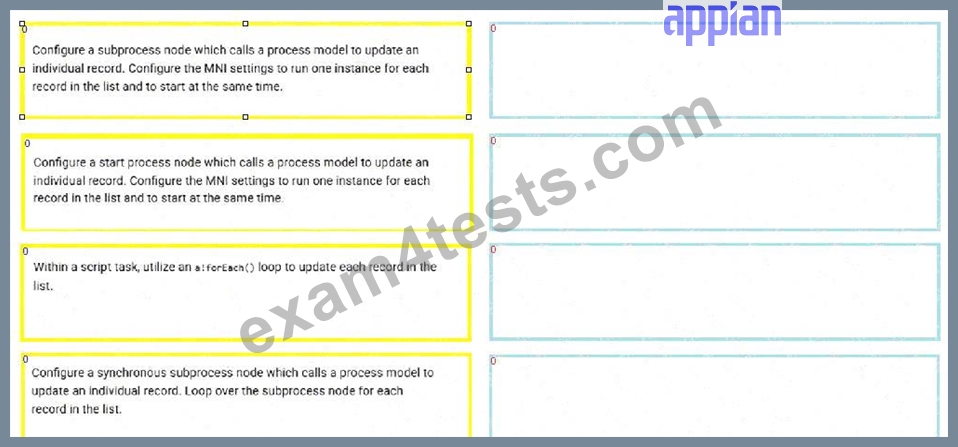
Answer:
Explanation: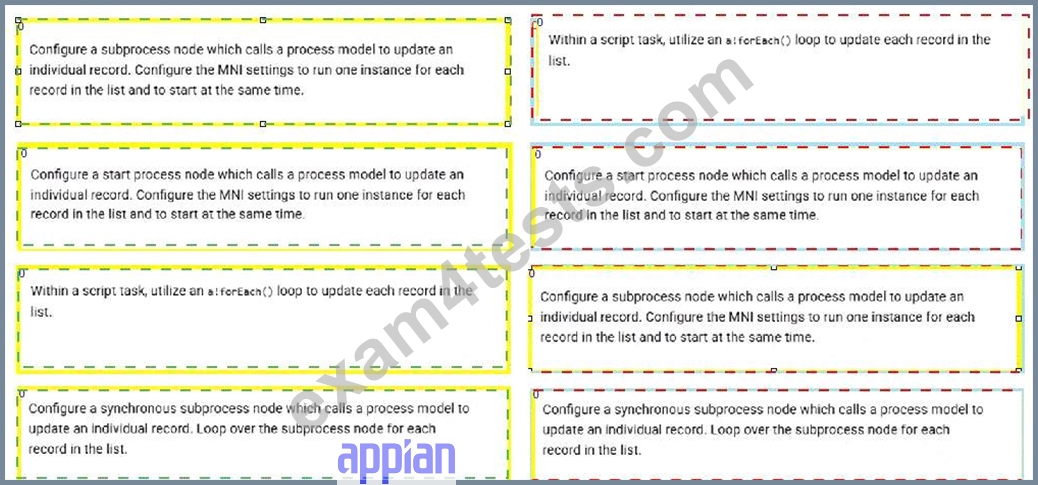
Explanation: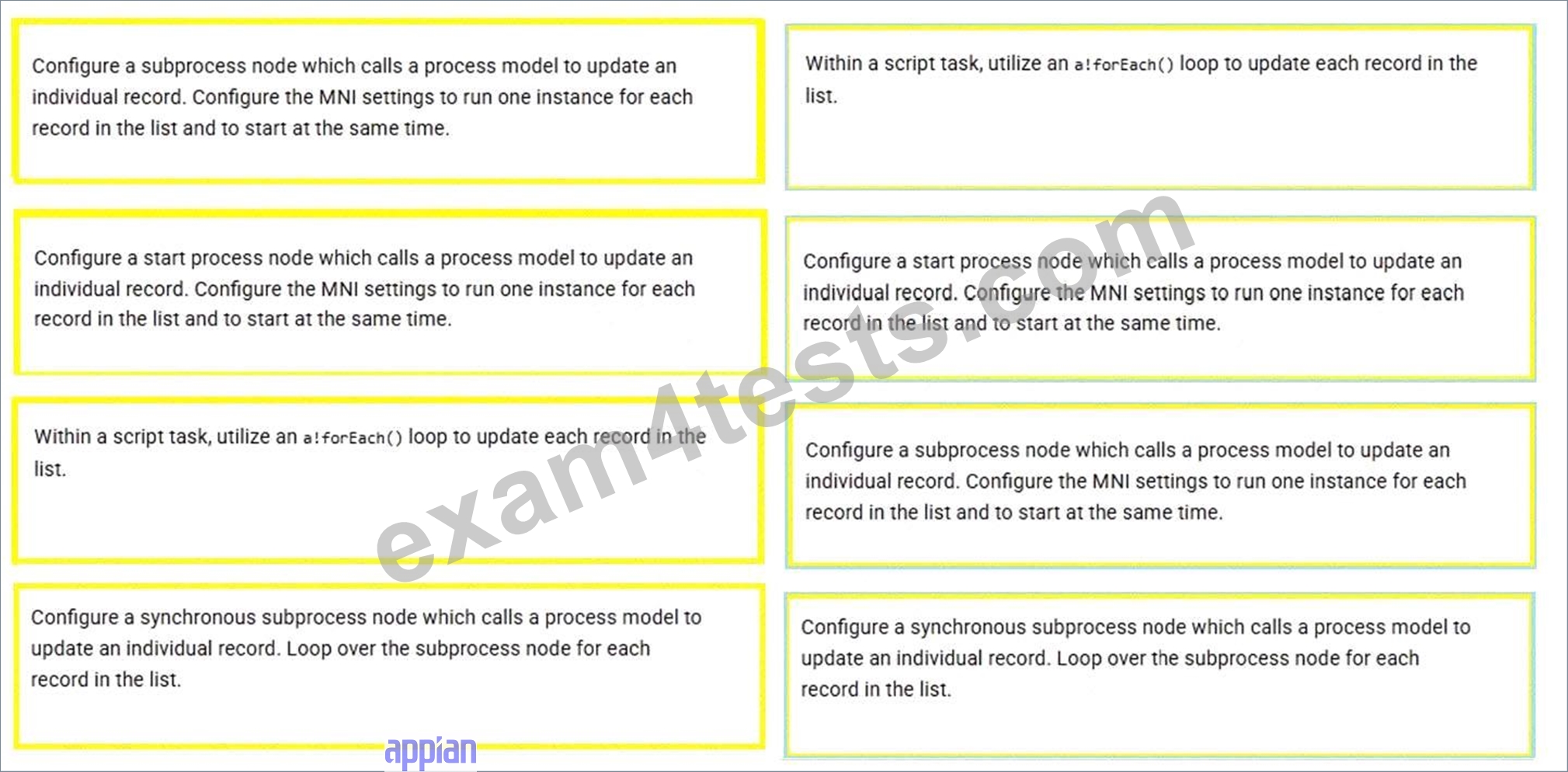
NEW QUESTION # 40
You run a report on different employee transactions by using a View.
You encounter the following error: "a!queryEntity: An error occurred while retrieving the data." What is the most likely root cause of this error?
- A. The view doesn't have a column mapped as a primary key in its corresponding CDT.
- B. The view contains a large number of rows, requiring more time to fetch the data.
- C. The rule contains a missing syntax.
Answer: A
Explanation:
The most likely root cause is that the view doesn't have a column mapped as a primary key in its corresponding CDT. Appian requires a primary key mapping for querying views to ensure data integrity and identification.
NEW QUESTION # 41
You have set up SAML for single sign-on (SSO) in your cloud environment.
Which three options could you enable in the Attribute Mapping section of the Admin Console to sync with a user's profile in Appian? (Choose three.)
- A. "Create new users upon sign in."
- B. "Remember Me on web and mobile.'
- C. "Reactivate deactivated users upon sign in."
- D. "Update user attributes upon sign in."
- E. "Group Membership Synchronization."
Answer: A,C,D
Explanation:
Create new users upon sign in - provisions new Appian users automatically when they first authenticate through SAML.
Reactivate deactivated users upon sign in - automatically re-enables an Appian account if the user returns after being deactivated.
Update user attributes upon sign in - refreshes profile details (e.g., name, email, custom attributes) each time the user signs in.
NEW QUESTION # 42
You're redesigning user interfaces to achieve more efficient space usage.
Which layout component is the best choice for displaying an interface with a vertical meaningful order of components?
- A. a!columnsLayout()
- B. a!cardLayout()
- C. a!sideBySideLayout()
Answer: A
Explanation:
a!columnsLayout() is best for organizing and displaying components in a vertical order with efficient space usage, as it supports arranging items in structured, responsive columns.
NEW QUESTION # 43
You're conducting a code review and notice that some accessibility features are missing on the interfaces.
Which two UX best practices should be followed to align with accessibility requirements? (Choose two.)
- A. Indicate the hierarchy of sections with a heading tag in addition to label sizes (for example: "H1").
- B. Use rich text items to act as headers for structuring interfaces.
- C. Apply a label value for all fields when the label position is "Hidden".
- D. Use a single rich text icon with "POSITIVE" or "NEGATIVE" styling to indicate statuses.
Answer: A,C
Explanation:
Applying a label value for all fields, even when the label position is hidden, ensures screen readers and assistive technologies can interpret the field correctly.
Indicating the hierarchy of sections with heading tags improves navigation for users with assistive technologies, aligning with accessibility standards.
NEW QUESTION # 44
In reviewing the process model metrics of your application, you notice a process model with a completion rate of only 10%.
What are two possible reasons for this low completion rate? (Choose two.)
- A. The process contains at least one User Input Task with no exceptions or escalations, and users do not complete the task.
- B. The days configured for archival or deletion is significantly higher than the other process models in your application.
- C. There are a significant number of instances that are experiencing process errors, which are not being handled by the production support team.
- D. There are a high number of smart service nodes configured in the process model.
Answer: A,C
Explanation:
Process errors that remain unhandled will stall instances; those instances never reach an end event, driving the completion rate down.
User-input tasks without deadlines, exceptions, or escalations can sit indefinitely when users do not act, leaving instances in an active state and lowering the overall completion percentage.
NEW QUESTION # 45
You need to add test cases to an existing expression rule in the system. Expression rule gives a complex data type value as an output result.
The test case should pass only when a field in the resultant data matches with a specific value mentioned.
How should you configure the test case assertion?
- A. Test output matches the asserted output.
- B. Assertion expression evaluates to True.
- C. Test completes without errors.
Answer: B
Explanation:
Configuring the test case assertion so that the assertion expression evaluates to True allows you to specifically check whether the desired field in the complex data type result matches the required value.
NEW QUESTION # 46
You need to test a related action that updates record data.
Appropriate users must be able to access the form. You also need to ensure that the data is successfully updated.
Using Appian, which is the best testing method you should use?
- A. User Accepting Testing
- B. Performance Testing
- C. Unit Testing
Answer: A
Explanation:
User Acceptance Testing (UAT) is the best method, as it ensures appropriate users can access the form and verifies that the data update process works as intended in a real-world scenario.
NEW QUESTION # 47
An energy company wants to allow the public to be able to report power outages directly and provide supporting documentation in the form of photos and/or videos. The company also requires the reporter's contact details.
How can a developer design and implement this requirement in Appian?
- A. A custom version of the Appian mobile app that the user can use to capture details, attached photos, and upload documents.
- B. A site where the user can trigger a process that captures the information including any uploaded files, and uploads everything to an internal Microsoft SharePoint site.
- C. A portal that interacts with records that stores the name, address, contact information, with a defined folder to store uploaded documents.
Answer: C
Explanation:
A portal interacting with records can capture public outage reports, contact details, and upload supporting documents to a defined folder, making the process accessible to the public without requiring authentication.
NEW QUESTION # 48
You need to update an existing Appian application.
The application needs to be responsive and compatible with a variety of screen widths. For example: phone
/tablet browser, Appian mobile app, desktop monitor.
Which two functions/parameters should you consider when updating the interfaces? (Choose two.)
- A. a!isNativeMobile()
- B. a!isPageWidth()
- C. Width of a page in the site object
- D. stackWhen in Columns Layout and Side By Side Layout
Answer: A,D
Explanation:
The stackWhen parameter in layout components helps interfaces adapt to different screen sizes by controlling when columns or side-by-side layouts stack vertically.
The a!isNativeMobile() function detects if the interface is being viewed on a native mobile app, allowing you to tailor the interface for mobile responsiveness.
NEW QUESTION # 49
You're developing a functionality to manage transactions for an insurance company. Each transaction can have multiple items where respective item type and item amount can be entered. The amount entered can be either negative or positive, and is a decimal data type with a precision of 8 and a scale of 2.
A maximum of 10 items can be entered for a transaction. Once all the items are entered, you need to calculate and show the sum of all items' total amounts at the transaction level.
What is the best way to calculate and display the sum of all item amounts?
- A. fixed(sum(ri!items.amount),2,false())
- B. text(sum(ri!items.amount),"00.00")
- C. round(sum(ri!items.amount),2)
Answer: A
Explanation:
fixed(sum(ri!items.amount),2,false()) is the best option because it returns the sum as a text value formatted to exactly two decimal places, which is ideal for currency or financial amounts. This ensures the total displays correctly as a string, maintaining precision and formatting for both positive and negative values.
NEW QUESTION # 50
You're creating a support case record type while working on a support case management system. You want to track support case status changes.
You want to use record events to track this information.
Which record data source type is the most appropriate for you to use?
- A. Database source with data sync enabled
- B. Process Model source with data sync enabled
- C. Web service without data sync enabled
Answer: A
Explanation:
A database source with data sync enabled is required to use record events for tracking support case status changes, as Appian record events are only supported for synced record types with a database as the data source.
NEW QUESTION # 51
You have a Case record type with data sync enabled to retrieve submitted support cases.
What is the best approach to limit who can see which records in the record type?
- A. Record-level security
- B. Default filters
- C. Security rules
Answer: A
Explanation:
Record-level security is the best approach for limiting which users can see specific records in a record type with data sync enabled, as it allows you to define access at the record level.
NEW QUESTION # 52
You have designed a three-step 'Wizard' form interaction using user input tasks in the process model. The second step of the Wizard must utilize another process model which contains a user input task inside.
Which two methods should be implemented for a seamless Wizard-like interaction for the user? (Choose two.)
- A. Use a subprocess to call the second process model.
- B. Use the Start Process smart service to call the second process model.
- C. Enable activity-chaining between all nodes on the main process model.
- D. Enable activity chaining between all nodes in the second process model, and activity chain between all user input tasks.
Answer: A,C
Explanation:
Enabling activity-chaining between all nodes on the main process model ensures the wizard steps flow seamlessly for the user.
Using a subprocess to call the second process model allows the main process to incorporate its user input task as part of the wizard flow with activity-chaining support.
NEW QUESTION # 53
You need to create a process workflow for employee background investigations. This workflow takes an average of six months from start to completion. There are multiple phases to the background investigation which must be completed by people in different departments. Each department is responsible for inputting a large amount of data as part of the workflow.
There is an emphasis on process memory management since thousands of these investigations will happen concurrently.
What are two best practices that you should employ when designing this process workflow? (Choose two.)
- A. Divide the workflow into multiple process models so that each process can be short-lived and consume less memory.
- B. Ensure that the data management policy is set to archive the process instances after a minimum of six months, so that data is available throughout the workflow.
- C. Combine all stages of the workflow into a single process model, so that data can be efficiently shared between nodes using process variables.
- D. Utilize a record-backed design throughout the workflow where data entered by users is saved to and queried from the database.
Answer: A,D
Explanation:
Using a record-backed design ensures data is persisted in the database, not held in memory, optimizing process memory management.
Dividing the workflow into multiple process models allows each to be short-lived, further reducing memory usage and improving scalability.
NEW QUESTION # 54
......
100% Reliable Microsoft ACD201 Exam Dumps Test Pdf Exam Material: https://braindumps.exam4tests.com/ACD201-pdf-braindumps.html