

1z1-829 Dumps 2024 - New Oracle 1z1-829 Exam Questions
Free 1z1-829 Braindumps Download Updated on Jan 15, 2024 with 50 Questions
NEW QUESTION # 28
Given the code fragment:
Which code fragment invokes all callable objects in the workers set?
- A.

- B.

- C.

- D.

Answer: D
Explanation:
The code fragment in Option C invokes all callable objects in the workers set by using the ExecutorService's invokeAll() method. This method takes a collection of Callable objects and returns a list of Future objects representing the results of the tasks. The other options are incorrect because they either use the wrong method (invokeAny() or submit()) or have syntax errors (missing parentheses or semicolons). Reference: AbstractExecutorService (Java SE 17 & JDK 17) - Oracle
NEW QUESTION # 29
Given the code fragment:
Which code line n1, obtains the java.io.Console object?
- A.

- B.

- C.

- D.

- E.

Answer: A
Explanation:
Explanation
The code fragment is trying to obtain the java.io.Console object, which is a class that provides methods to access the character-based console device, if any, associated with the current Java virtual machine. The correct way to obtain the Console object is to call the static method Console console() in the java.lang.System class.
This method returns the unique Console object associated with the current Java virtual machine, if any.
Therefore, option A is correct, as it calls System.console() and assigns it to a Console variable. References:
https://docs.oracle.com/javase/17/docs/api/java.base/java/io/Console.html
https://docs.oracle.com/javase/17/docs/api/java.base/java/lang/System.html#console()
https://education.oracle.com/products/trackp_OCPJSE17
https://mylearn.oracle.com/ou/learning-path/java-se-17-developer/99487
NEW QUESTION # 30
Given:
What is the result?
- A. Bicycle =7, car=7, motorcycle=7, truck=7)
- B. (Bicycle, car, motorcycle, truck)
- C. (3:bicycle, 0:car, 0motercycle, 5:truck)
- D. Compilation fails.
- E. Bicycle-1, car=3, motorcycle=1, truck=2)
Answer: D
Explanation:
Explanation
The answer is E because the code fragment contains several syntax errors that prevent it from compiling.
Some of the errors are:
The enum declaration is missing a semicolon after the list of constants.
The enum constants are not capitalized, which violates the Java naming convention for enums.
The switch expression is missing parentheses around the variable name.
The case labels are missing colons after the enum constants.
The default label is missing a break statement, which causes a fall-through to the next case.
The println statement is missing a closing parenthesis and a semicolon.
A possible corrected version of the code fragment is:
enum Vehicle { BICYCLE, CAR, MOTORCYCLE, TRUCK; } public class Test { public static void main(String[] args) { Vehicle v = Vehicle.BICYCLE; switch (v) { case BICYCLE: System.out.print("1"); break; case CAR: System.out.print("3"); break; case MOTORCYCLE: System.out.print("1"); break; case TRUCK: System.out.print("2"); break; default: System.out.print("0"); break; } System.out.println(); } } This would print 1 as the output. References:
Oracle Certified Professional: Java SE 17 Developer
Java SE 17 Developer
OCP Oracle Certified Professional Java SE 17 Developer Study Guide
Enum Types
The switch Statement
NEW QUESTION # 31
Given:
What is the result
- A. Marketing
- B. Marketing
Finance
Technical - C. Marketing
Undefined - D. UnDefined
Answer: D
Explanation:
Explanation
The code fragment is using the switch statement with the new Java 17 syntax. The switch statement checks the value of the variable desig and executes the corresponding case statement. In this case, the value of desig is
"CTO", which does not match any of the case labels. Therefore, the default case statement is executed, which prints "Undefined". The other case statements are not executed, because there is no fall through in the new syntax. Therefore, the output of the code fragment is:
Undefined
NEW QUESTION # 32
Given the code fragment:
What is the result?
- A. 0
- B. 1
- C. 2
- D. 3
- E. 4
- F. 5
Answer: E
Explanation:
Explanation
The code fragment is creating a string variable "a" with the value "Hello! Java". Then, it is printing the index of "Java" in "a". Next, it is replacing "Hello!" with "Welcome!" in "a". Then, it is printing the index of "Java" in "a". Finally, it is creating a new StringBuilder object "b" with the value of "a" and printing the index of
"Java" in "b". The output will be 8109 because the index of "Java" in "a" is 8, the index of "Java" in "a" after replacing "Hello!" with "Welcome!" is 10, and the index of "Java" in "b" is 9. References: Oracle Java SE 17 Developer source and documents: [String (Java SE 17 & JDK 17)], [StringBuilder (Java SE 17 & JDK 17)]
NEW QUESTION # 33
Assuming that the data, txt file exists and has the following content:
Text1
Text2
Text3
Given the code fragment:
What is the result?
- A. text1-
text2-
text3-
text3 - B. text1-text2-text3
text3 - C. text1-text2-text3
text1
text2
text3 - D. text1-text2-text3
A java.lang.indexoutofBoundsException is thrown.
Answer: B
Explanation:
The answer is D because the code fragment reads the file "data.txt" and collects all the lines in the file into a single string, separated by hyphens. Then, it prints the resulting string. Next, it attempts to read the fourth line in the file (index 3) and print it. However, since the file only has three lines, an IndexOutOfBoundsException is thrown. Reference:
Oracle Certified Professional: Java SE 17 Developer
Java SE 17 Developer
OCP Oracle Certified Professional Java SE 17 Developer Study Guide
Read contents of a file using Files class in Java
NEW QUESTION # 34
Given the directory structure:
Given the definition of the Doc class:
Which two are valid definition of the wordDoc class?
- A. Package p1,
non-sealed abstract class WordDoc extends Doc () - B. Package p1, p2;
Public non-sealed class WordDoc extends Doc () - C. Package p1;
Public final class WordDoc extends Doc () - D. Package p1;
Public non-sealed class wordDoc extends Doc () - E. Package p1;
Public class wordDoc extends Doc () - F. Package p1, p2;
Public sealed class WordDoc extends Doc ()
Answer: C,D
Explanation:
The correct answer is A and F because the wordDoc class must be a non-sealed class or a final class to extend the sealed Doc class. Option B is incorrect because the wordDoc class must be non-sealed or final. Option C is incorrect because the wordDoc class cannot be in a different package than the Doc class. Option D is incorrect because the wordDoc class cannot be a sealed class. Option E is incorrect because the wordDoc class cannot be an abstract class. Reference: Oracle Certified Professional: Java SE 17 Developer, 3 Sealed Classes - Oracle Help Center
NEW QUESTION # 35
Assuming that the data, txt file exists and has the following content:
Text1
Text2
Text3
Given the code fragment:
What is the result?
- A. text1-
text2-
text3-
text3 - B. text1-text2-text3
text3 - C. text1-text2-text3
text1
text2
text3 - D. text1-text2-text3
A java.lang.indexoutofBoundsException is thrown.
Answer: B
Explanation:
Explanation
The answer is D because the code fragment reads the file "data.txt" and collects all the lines in the file into a single string, separated by hyphens. Then, it prints the resulting string. Next, it attempts to read the fourth line in the file (index 3) and print it. However, since the file only has three lines, an IndexOutOfBoundsException is thrown. References:
Oracle Certified Professional: Java SE 17 Developer
Java SE 17 Developer
OCP Oracle Certified Professional Java SE 17 Developer Study Guide
Read contents of a file using Files class in Java
NEW QUESTION # 36
Given:
What is the result?
- A. Software game write error
- B. Software Game Chess 0
- C. Software Game Chess 2
- D. Software Game Software Game Chese 2
- E. Software Game read error
- F. Software Game Software Game chess 0
Answer: D
Explanation:
The answer is B because the code uses the writeObject and readObject methods of the ObjectOutputStream and ObjectInputStream classes to serialize and deserialize the Game object. These methods use the default serialization mechanism, which writes and reads the state of the object's fields, including the inherited ones. Therefore, the title field of the Software class is also serialized and deserialized along with the players field of the Game class. The toString method of the Game class calls the toString method of the Software class using super.toString(), which returns the value of the title field. Hence, when the deserialized object is printed, it shows "Software Game Software Game Chess 2". Reference:
Oracle Certified Professional: Java SE 17 Developer
Java SE 17 Developer
OCP Oracle Certified Professional Java SE 17 Developer Study Guide
Serialization and Deserialization in Java with Example
NEW QUESTION # 37
Given the code fragment:
Which two statements at Line nl independently enable you to print 1250?
- A. Integer res= 250 + s2;
- B. Integer res = 250; Res = + s2;
- C. Integer res = 250 + integer . valueof (s);
- D. Integer res = 250 + integer.parseint (s)
- E. Integer res = 250 + s:
- F. Integer res = 250 + integer (s2):
Answer: C,D
Explanation:
Explanation
The code fragment is creating a string variable "s" with the value "10_00" and an integer variable "s2" with the value 10. The string "s" is using an underscore as a separator for readability, which is allowed in Java SE
171. The question is asking for two statements that can add 250 to the numeric value of "s" and assign it to an integer variable "res". The correct answers are A and E because they use the methods parseInt and valueOf of the Integer class to convert the string "s" to an integer. Both methods interpret the string as a signed decimal integer and return the equivalent int or Integer value23. The other options are incorrect because they either use invalid syntax, such as B and C, or they do not convert the string "s" to an integer, such as D and F: References: Binary Literals (The Java™ Tutorials > Learning the Java Language > Numbers and Strings), Integer (Java SE 17 & JDK 17), Integer (Java SE 17 & JDK 17)
NEW QUESTION # 38
Given:
Which two modifications enable the code to print Open Close?
- A.

- B.

- C.

- D.

- E.

Answer: A,B
Explanation:
The code given is a try-with-resources statement that declares a resource of type AutoCloseable. The resource is an anonymous class that implements the AutoCloseable interface and overrides the close() method. The code also has a print() method that prints the value of the variable s. The code is supposed to print "Open Close", but it does not compile because of two errors.
The first error is at line n1, where the anonymous class is missing a semicolon at the end of its declaration. This causes a syntax error and prevents the code from compiling. To fix this error, option B adds a semicolon after the closing curly brace of the anonymous class.
The second error is at line n2, where the print() method is called without an object reference. This causes a compilation error because the print() method is not static and cannot be invoked without an object. To fix this error, option E adds an object reference to the print() method by using the variable t.
Therefore, options B and E are correct and enable the code to print "Open Close".
NEW QUESTION # 39
Given the product class:
And the shop class:
What is the result?
- A. Cookie 2.99 2.99
- B. Cookie 0.0 2.99
- C. An exception is produced at runtime
- D. Cookie 0.0 0.0
- E. Cookie 3.99 2.99
- F. Compilation fails
Answer: F
Explanation:
Explanation
The code fragment will fail to compile because the readObject method in the Product class is missing the
@Override annotation. The readObject method is a special method that is used to customize the deserialization process of an object. It must be declared as private, have no return type, and take a single parameter of type ObjectInputStream. It must also be annotated with @Override to indicate that it overrides the default behavior of the ObjectInputStream class. Without the @Override annotation, the compiler will treat the readObject method as a normal method and not as a deserialization hook. Therefore, the code fragment will produce a compilation error. References: Object Serialization - Oracle, [ObjectInputStream (Java SE 17 & JDK 17) - Oracle]
NEW QUESTION # 40
Given the code fragment:
Which action enables the code to compile?
- A. Make the regNo variable public
- B. Make the regNo variable static.
- C. Replace record with void.
- D. Remove the regNO initialization statement.
- E. Replace thye regNo variable static
Answer: A
Explanation:
Explanation
The code will compile if the regNo variable is made public. This is because the regNo variable is being accessed in the main method of the App class, which is outside the scope of the Product class. Making the regNo variable public will allow it to be accessed from outside the class. References:
https://education.oracle.com/products/trackp_OCPJSE17,
https://mylearn.oracle.com/ou/learning-path/java-se-17-developer/99487,
https://docs.oracle.com/javase/tutorial/java/javaOO/accesscontrol.html
NEW QUESTION # 41
Given:
Which two method invocation execute?
- A. iFace mucloassObj = new Myc ();
myClassObj.m4(); - B. IFace myclassobj = new Myc ();
myclassObj.m3 (); - C. IFace .,4():
- D. Ifnce.m3 ();
- E. IFace.m2();
- F. new MyC() .m2 ();
Answer: C,F
Explanation:
The code given is an interface and a class that implements the interface. The interface has three methods, m1(), m2(), and m3(). The class has one method, m1(). The only two method invocations that will execute are D and E. D is a call to the m2() method in the class, and E is a call to the m3() method in the interface. Reference: https://education.oracle.com/products/trackp_OCPJSE17, 3, 4, 5
NEW QUESTION # 42
Given the code fragment:
What is the result?
- A. Range 1
Range 2
Range 3 - B. Range 1
Range 2
Range 3
Range 1
Not a valida rank - C. Range 1
- D. Range1
Note a valid rank.
Answer: B
Explanation:
The code fragment is using the switch statement with the new Java 17 syntax. The switch statement checks the value of the variable rank and executes the corresponding case statement. In this case, the value of rank is 4, so the first case statement is executed, printing "Range1". The second and third case statements are also executed, printing "Range2" and "Range3". The default case statement is also executed, printing "Not a valid rank". Reference: Java Language Changes - Oracle Help Center
NEW QUESTION # 43
Given:
What is the result?
- A. User name (EN)
- B. UserName
- C. User name (US)
- D. User name (EN - US)
- E. The program throws a MissingResourceException.
Answer: E
Explanation:
The answer is B because the code fragment contains a logical error that causes a MissingResourceException at runtime. The code fragment tries to load a resource bundle with the base name "Captions.properties" and the locale "en_US". However, there is no such resource bundle available in the classpath. The available resource bundles are:
Captions.properties
Captions_en.properties
Captions_US.properties
Captions_en_US.properties
The ResourceBundle class follows a fallback mechanism to find the best matching resource bundle for a given locale. It first tries to find the resource bundle with the exact locale, then it tries to find the resource bundle with the same language and script, then it tries to find the resource bundle with the same language, and finally it tries to find the default resource bundle with no locale. If none of these resource bundles are found, it throws a MissingResourceException.
In this case, the code fragment is looking for a resource bundle with the base name "Captions.properties" and the locale "en_US". The ResourceBundle class will try to find the following resource bundles in order:
Captions.properties_en_US
Captions.properties_en
Captions.properties
However, none of these resource bundles exist in the classpath. Therefore, the ResourceBundle class will throw a MissingResourceException.
To fix this error, the code fragment should use the correct base name of the resource bundle family, which is "Captions" without the ".properties" extension. For example:
ResourceBundle captions = ResourceBundle.getBundle("Captions", currentLocale); This will load the appropriate resource bundle for the current locale, which is "Captions_en_US.properties" in this case. Reference:
Oracle Certified Professional: Java SE 17 Developer
Java SE 17 Developer
OCP Oracle Certified Professional Java SE 17 Developer Study Guide
ResourceBundle (Java Platform SE 8 )
About the ResourceBundle Class (The Java™ Tutorials > Internationalization)
NEW QUESTION # 44
Assume you have an automatic module from the module path display-ascii-0.2. jar. Which name is given to the automatic module based on the given JAR file?
- A. Display.ascii
- B. Display-ascii-0
- C. Display-ascii
- D. Display-ascii-0.2
Answer: C
Explanation:
Explanation
An automatic module name is derived from the name of the JAR file when it does not contain a module-info.class file. If the JAR file has an "Automatic-Module-Name" attribute in its main manifest, then its value is the module name. Otherwise, the module name is derived from the JAR file's name by removing any version numbers and converting it to lower case. Therefore, for a JAR named display-ascii-0.2.jar, the automatic module name would be display-ascii, following these rules.
NEW QUESTION # 45
Which two code fragments compile?
- A.

- B.

- C.

- D.
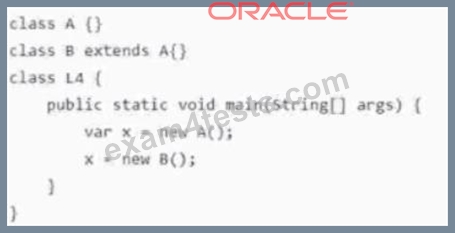
- E.

Answer: B,E
Explanation:
The two code fragments that compile are B and E. These are the only ones that use the correct syntax for declaring and initializing a var variable. The var keyword is a reserved type name that allows the compiler to infer the type of the variable based on the initializer expression. However, the var variable must have an initializer, and the initializer must not be null or a lambda expression. Therefore, option A is invalid because it does not have an initializer, option C is invalid because it has a null initializer, and option D is invalid because it has a lambda expression as an initializer. Option B is valid because it has a String initializer, and option E is valid because it has an int initializer.
https://docs.oracle.com/en/java/javase/17/language/local-variable-type-inference.html
NEW QUESTION # 46
Given:
Which action enables the code to compile?
- A. Replace 15 with item.display (''Flower'');
- B. Replace 7 with public void display (string design) {
- C. Replace 3 with private static void display () {
- D. Replace 2 with static string name;
Answer: B
Explanation:
The answer is C because the code fragment contains a syntax error in line 7, where the method display is declared without any parameter type. This causes a compilation error, as Java requires the parameter type to be specified for each method parameter. To fix this error, the parameter type should be added before the parameter name, such as string design. This will enable the code to compile and run without any errors. Reference:
Oracle Certified Professional: Java SE 17 Developer
Java SE 17 Developer
OCP Oracle Certified Professional Java SE 17 Developer Study Guide
Java Methods
NEW QUESTION # 47
Given the code fragments:
Which action prints Wagon : 200?
- A. At line n2, in the main method signature, add throws IoException, ClassNotFoundException.
- B. At line n3, replace readObject (0 with readLine().
- C. At Line n1, implement the java.io.AutoCloseable interface
- D. At Line n3, replace Car with LuxurayCar.
- E. At line n2, in the main method signature, add throws IOException, ClassCastException.
- F. At line n1, implement the java.io, Serializable interface.
Answer: A
Explanation:
Explanation
The code fragment is trying to read an object from a file using the ObjectInputStream class. This class throws an IOException and a ClassNotFoundException. To handle these exceptions, the main method signature should declare that it throws these exceptions. Otherwise, the code will not compile. If the main method throws these exceptions, the code will print Wagon : 200, which is the result of calling the toString method of the LuxuryCar object that was written to the file. References: ObjectInputStream (Java SE 17 & JDK 17) - Oracle, ObjectOutputStream (Java SE 17 & JDK 17) - Oracle
NEW QUESTION # 48
Given:
What is the result?
- A. User name (EN)
- B. UserName
- C. User name (US)
- D. User name (EN - US)
- E. The program throws a MissingResourceException.
Answer: E
Explanation:
Explanation
The answer is B because the code fragment contains a logical error that causes a MissingResourceException at runtime. The code fragment tries to load a resource bundle with the base name "Captions.properties" and the locale "en_US". However, there is no such resource bundle available in the classpath. The available resource bundles are:
Captions.properties
Captions_en.properties
Captions_US.properties
Captions_en_US.properties
The ResourceBundle class follows a fallback mechanism to find the best matching resource bundle for a given locale. It first tries to find the resource bundle with the exact locale, then it tries to find the resource bundle with the same language and script, then it tries to find the resource bundle with the same language, and finally it tries to find the default resource bundle with no locale. If none of these resource bundles are found, it throws a MissingResourceException.
In this case, the code fragment is looking for a resource bundle with the base name "Captions.properties" and the locale "en_US". The ResourceBundle class will try to find the following resource bundles in order:
Captions.properties_en_US
Captions.properties_en
Captions.properties
However, none of these resource bundles exist in the classpath. Therefore, the ResourceBundle class will throw a MissingResourceException.
To fix this error, the code fragment should use the correct base name of the resource bundle family, which is
"Captions" without the ".properties" extension. For example:
ResourceBundle captions = ResourceBundle.getBundle("Captions", currentLocale); This will load the appropriate resource bundle for the current locale, which is "Captions_en_US.properties" in this case. References:
Oracle Certified Professional: Java SE 17 Developer
Java SE 17 Developer
OCP Oracle Certified Professional Java SE 17 Developer Study Guide
ResourceBundle (Java Platform SE 8 )
About the ResourceBundle Class (The Java™ Tutorials > Internationalization)
NEW QUESTION # 49
......
Oracle 1z1-829 Exam Practice Test Questions: https://braindumps.exam4tests.com/1z1-829-pdf-braindumps.html