

2026 Latest DEA-C02 dumps Exam Material with 354 Questions
Snowflake DEA-C02 Questions and Answers Guarantee you Oass the Test Easily
NEW QUESTION # 27
You have a complex data pipeline implemented using Snow park Python. The pipeline involves multiple Data Frame transformations, joins, aggregations, and window functions. To enhance the maintainability and readability of the code, you want to modularize the pipeline into reusable functions. You also need to handle potential errors and exceptions gracefully. Consider the following code snippet:
- A.

- B.

- C.
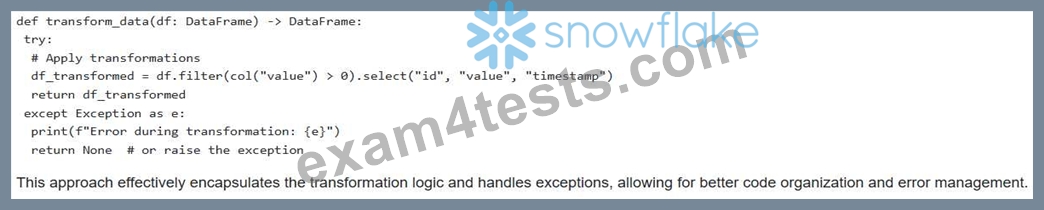
- D.

Answer: A,D
Explanation:
Options B and D represent robust approaches to modularizing and handling errors in Snowpark pipelines. Option B demonstrates reusability by parameterizing the session and table name and returning a DataFrame. A: try except is good but lacks session and table name parameters for resuablity Option D demonstrates logging error details to a dedicated table to provide insights for auditing.
NEW QUESTION # 28
You are developing a JavaScript stored procedure in Snowflake using Snowpark to perform a complex data transformation. This transformation involves multiple steps: filtering, joining with another table, and aggregating data'. You need to ensure that the stored procedure is resilient to failures and can be easily debugged. Which of the following practices would contribute to the robustness and debuggability of your stored procedure? (Select all that apply)
- A. Using Snowpark's logging capabilities to record intermediate results and error messages at various stages of the transformation.
- B. Relying solely on try-catch blocks within the stored procedure to handle all potential exceptions.
- C. Passing the 'snowflake' binding as an argument to each modular function to facilitate logging and SQL execution within those functions.
- D. Directly manipulating the Snowflake metadata (e.g., table schemas) within the stored procedure for dynamic schema evolution.
- E. Breaking down the complex transformation into smaller, modular functions within the stored procedure and testing each function independently.
Answer: A,C,E
Explanation:
Options B, C, and D are correct. Logging intermediate results allows you to track the flow of data and identify the point of failure. Modularizing the code and testing individual functions makes debugging easier. Passing the 'snowflake' binding allows each module to log and execute SQL. Option A is insufficient, complex error requires more granular logging. Option E is dangerous and should be avoided as metadata changes should ideally be performed outside of transformation stored procedure and should be managed by orchestration tools.
NEW QUESTION # 29
You are tasked with loading a large dataset (50TB) of JSON files into Snowflake. The JSON files are complex, deeply nested, and irregularly structured. You want to maximize loading performance while minimizing storage costs and ensuring data integrity. You have a dedicated Snowflake virtual warehouse (X-Large).
Which combination of approaches would be MOST effective?
- A. Pre-process the JSON data using a Python script with Pandas to flatten the structure and convert it into a relational format like CSV. Then, load the CSV files using the COPY INTO command with gzip compression.
- B. Use Snowpipe with auto-ingest, create a raw VARIANT column alongside projected relational columns for frequently accessed fields, and use search optimization on those projected columns.
- C. Load the JSON data using the COPY INTO command with no pre-processing. Create a VIEW on top of the raw VARIANT column to flatten the data for querying.
- D. Load the JSON data using the COPY INTO command with gzip compression. Create a raw VARIANT column alongside projected relational columns for frequently accessed fields, and use materialized views to improve query performance.
- E. Use Snowpipe with auto-ingest, create a single VARIANT column in your target table, and rely solely on Snowflake's automatic schema detection.
Answer: B
Explanation:
Option C is the most effective. Snowpipe provides continuous loading. A raw VARIANT column captures all data, and projecting commonly accessed fields into relational columns optimizes query performance. Search optimization on the projected columns allows for faster filtering and lookups. Options A, B, D, and E have trade-offs. A lacks optimized querying and can lead to expensive computations on the variant column. B requires pre-processing and may lose data fidelity. D impacts query performance due to runtime flattening. E introduces complexities with materialized view maintenance.
NEW QUESTION # 30
You are designing a Snowpipe pipeline to ingest data from an AWS SQS queue. The queue contains notifications about new files arriving in an S3 bucket. However, due to network issues, some notifications are delayed, causing Snowpipe to potentially miss files. Which of the following strategies, when combined, will BEST address the problem of delayed notifications and ensure data completeness?
- A. Use 'VALIDATE()' function periodically to identify files that have not been loaded and trigger manual data loads for missing data.
- B. Set 'MAX FILE_AGE to 'DEFAULT' and utilize the 'SYSTEM$PIPE FORCE RESUME' procedure in conjunction with a separate process that lists the S3 bucket and compares it to the files already loaded in Snowflake, loading any missing files.
- C. Implement a Lambda function that triggers the 'SYSTEM$PIPE FORCE RESUME procedure after a certain delay.
- D. Configure the SQS queue with a longer retention period and implement an event bridge rule with a retry policy to resend notifications.
- E. Increase the 'MAX FILE AGE parameter in the Snowpipe definition and implement a periodic 'ALTER PIPE ... REFRESH' command.
Answer: B
Explanation:
Option E provides the most robust solution. Setting 'MAX FILE AGE to 'DEFAULT' ensures that Snowpipe considers all files, regardless of their age. 'SYSTEM$PIPE FORCE RESUME' can help in some cases. The key component is the supplemental process that actively compares the S3 bucket contents with the loaded data, identifying and loading any missing files due to delayed notifications. This approach guarantees data completeness even with delayed or missed SQS notifications. A,B,C,D doesn't guarantee data completeness. A alone can cause huge latency issue. B is not optimal. C addresses the SQS issue but not guaranteed to catch every case. D requires manual load intervention
NEW QUESTION # 31
A financial institution needs to tokenize sensitive customer data (credit card numbers) stored in a Snowflake table named 'CUSTOMER_DATA before it's consumed by a downstream reporting application. The institution uses an external tokenization service accessible via a REST API. Which of the following approaches is the MOST secure and scalable way to implement tokenization during data loading, minimizing exposure of the raw credit card data within Snowflake?
- A. Utilize Snowflake's Snowpipe to ingest the data directly. Inside a COPY INTO statement, use an external function to call the tokenization service during the ingestion process to tokenize the data before it's loaded into the target table.
- B. Load the raw data directly into the 'CUSTOMER DATA' table. Create a masking policy that utilizes a UDF that calls the external tokenization API directly to tokenize the credit card number values on read.
- C. Use a Snowflake UDF (User-Defined Function) written in Java that calls the external tokenization API directly. Create a masking policy that utilizes the UDF and applies it to the credit card number column.
- D. Load the raw data into a staging table, then create a Snowflake Task that executes a stored procedure. The stored procedure calls the external tokenization API using 'SYSTEM$EXTERNAL_FUNCTION_REQUEST' for each row and updates the original table with the tokenized values.
- E. Use Snowflake's Data Sharing feature to securely share the raw data with the downstream application, instructing them to perform the tokenization within their own environment.
Answer: A
Explanation:
Option E is the most secure and scalable approach. It tokenizes the data during the load process, minimizing the amount of time the raw data resides in Snowflake. Using a UDF in a masking policy (options A and C) tokenizes the data on read, meaning the raw data is stored in Snowflake. Option B, using a stored procedure and , can be less efficient for large datasets. Data sharing raw data (Option D) defeats the purpose of tokenization for the source environment.
NEW QUESTION # 32
You have a table named 'EMPLOYEES with a retention period of 1 day. You accidentally deleted several important rows from this table, but you need to recover the data'. You know the deletion occurred 25 hours ago. What actions should be taken to attempt to recover the deleted data, and what outcome can you expect? Assume you are working in an Enterprise edition of Snowflake account.
- A. Attempt to use Time Travel or cloning to recover the data. Expect the recovery to fail because the deletion occurred outside the I-day data retention period.
- B. Attempt to use Time Travel to query the table before the deletion and re-insert the deleted rows. Expect the recovery to be successful as long as the deletion occurred within the data retention period.
- C. Attempt to clone the table using Time Travel to a point in time before the deletion, then extract the deleted rows. Expect the recovery to be successful as long as the deletion occurred within the data retention period.
- D. Since its Enterprise edition of Snowflake account, the Time travel and cloning will work with 7 days retention period, hence attemtp clone table using Time Travel and recover data successfully
- E. Attempt to use UNDROP TABLE command if the table was dropped. Expect the recovery to be successful as long as the deletion occurred within the data retention period.
Answer: A
Explanation:
Option D is the correct answer. Snowflake's Time Travel feature allows data recovery within the defined data retention period. Since the deletion occurred 25 hours ago and the retention period is only 1 day (24 hours), the data is no longer recoverable using Time Travel or cloning. It's important to note that even if the deletion was only 25 hours ago, it still outside of the I-day data retention period.
NEW QUESTION # 33
You have implemented a Snowpipe using auto-ingest to load data from an AWS S3 bucket. The pipe is configured to load data into a table with a 'DATE column ('TRANSACTION DATE'). The data files in S3 contain a date field in the format 'YYYYMMDD'. Occasionally, you observe data loading failures in Snowpipe with the error message indicating an issue converting the string to a date. The 'FILE FORMAT' definition includes 'DATE FORMAT = 'YYYYMMDD''. Furthermore, you are also noticing that after a while, some files are not being ingested even though they are present in the S3 bucket. How to effectively diagnose and resolve these issues?
- A. Verify that the 'DATE FORMAT is correct and that all files consistently adhere to this format. Check for corrupted files in S3 that may be preventing Snowpipe from processing subsequent files. Additionally, review the Snowpipe error notifications in Snowflake to identify the root cause of ingestion failures. Use 'SYSTEM$PIPE to troubleshoot the files not ingested
- B. The issue may arise if the time zone of the Snowflake account does not match the time zone of your data in AWS S3. Try setting the 'TIMEZONE parameter in the FILE FORMAT definition. For files that are not being ingested, manually refresh the Snowpipe with 'ALTER PIPE ... REFRESH'.
- C. Snowflake's auto-ingest feature has limitations and may not be suitable for inconsistent data formats. Consider using the Snowpipe REST API to implement custom error handling and data validation logic. Monitor the Snowflake event queue to ensure events are being received.
- D. The error could be due to invalid characters in the source data files. Implement data cleansing steps to remove invalid characters from the date fields before uploading to S3. For files not being ingested, check S3 event notifications for missing or failed events.
- E. The 'DATE FORMAT parameter is case-sensitive. Ensure it matches the case of the incoming data. Also, check the 'VALIDATION MODE and ERROR parameters to ensure error handling is appropriately configured for files with date format errors. For the files that are not ingested use 'SYSTEM$PIPE to find the cause of the issue.
Answer: A,E
Explanation:
Option A is partially correct as the validation _ mode parameter in file format needs to be reviewed, not only the casesensitivity for the date. Case sensitivity isn't strictly enforced for DATE FORMAT. Snowflake's documentation specifies the valid specifiers (YYYY, MM, DD, etc.) which are generally case-insensitive in this context.The 'VALIDATION MODE and 'ON ERROR parameters in the copy option are critical. Incorrect handling of files that fails can cause future file ingests to stop. Option E highlights the importance of verifying the data format consistency and checking for corrupted files. Corrupted files or files that do not adhere to the specified format can cause Snowpipe to fail and potentially stop processing further files. Option B is incorrect, while timezone mismatches can cause issues, they don't directly lead to data loading failures with format conversion if the format is wrong or if file validation caused the issue. Option C's suggestion of data cleansing is valid in general, but it addresses a different problem (data quality) than the specific error described in the question. Option D proposes switching to the REST API, which is an overkill for this scenario. The auto-ingest feature is suitable; the problem is likely with data format inconsistencies or error handling.
NEW QUESTION # 34
You have a 'WEB EVENTS' table that stores user activity on a website. It includes columns like 'USER ID, 'EVENT TYPE , EVENT TIMESTAMP, and 'PAGE URL'. You need to create a materialized view that calculates the number of distinct users visiting each page daily. You are also tasked with minimizing the impact on the underlying 'WEB EVENTS' table during materialized view refreshes, as other critical processes rely on it. Which of the following strategies would provide the MOST efficient solution, considering both performance and concurrency?
- A. Create a materialized view and configure it to incrementally refresh, leveraging Snowflake's automatic refresh capabilities without any explicit scheduling.
- B. Create a materialized view with a 'REFRESH COMPLETE strategy to ensure full data consistency after each refresh, even though it may lock the underlying table.
- C. Create a materialized view and schedule regular, small batch refreshes to minimize lock contention and resource consumption on the 'WEB_EVENTS' table.
- D. Create a task that truncates and reloads the materialized view daily. This ensures data consistency and prevents incremental refresh issues.
- E. Create a standard materialized view that calculates the distinct user count per page daily directly from the 'WEB EVENTS table without any special configuration.
Answer: A
Explanation:
Option D provides the most efficient solution. Incremental refreshes are designed to efficiently update the materialized view with only the changes from the base table, minimizing the impact on the 'WEB_EVENTS' table. Options A, B and E might lock the table for longer periods. Option C is not a valid option in Snowflake. Option E is not efficient since it involves truncating and reloading the materialized view, consuming unnecessary resources and being potentially slow.
NEW QUESTION # 35
A data engineer needs to optimize the performance of a series of complex transformations performed using Snowflake stored procedures. These procedures involve multiple table joins, aggregations, and data filtering operations. The current execution time is unacceptably long. Which of the following optimization strategies are most likely to provide the greatest performance improvements, considering both code-level optimizations and Snowflake's architecture? Select all that apply.
- A. Ensure the underlying tables are appropriately clustered and consider using materialized views for frequently accessed aggregations or pre-computed results to improve query performance.
- B. Rewrite the stored procedures to use procedural logic (e.g., loops and cursors) more extensively, as this allows for fine-grained control over the execution flow and can improve performance for certain operations.
- C. Refactor the stored procedures to leverage set-based operations (e.g., using SQL statements with joins and aggregations) whenever possible, allowing Snowflake to parallelize the execution across multiple nodes.
- D. Implement data caching within the stored procedures using temporary tables to store intermediate results, reducing the need to repeatedly query the same data.
- E. Use external functions written in languages like Python or Java for computationally intensive tasks that are not efficiently handled by SQL, taking advantage of Snowflake's support for external functions.
Answer: A,C,D
Explanation:
Snowflake is designed for parallel processing of set-based operations. Using procedural logic limits its ability to parallelize. Caching intermediate results using temporary tables can significantly reduce redundant computations. Finally, using appropriate clustering and materialized views are fundamental optimization techniques in Snowflake. External functions should be considered when the task is impossible or highly inefficient to implement in SQL. Option A is incorrect because procedural logic often hinders Snowflake's parallel processing capabilities.
NEW QUESTION # 36
You're managing a Snowflake data warehouse and need to create a development environment for testing a complex stored procedure that updates a critical table, 'SALES DATA'. The procedure is located in the 'PRODUCTION' database and you want to ensure minimal impact to the production environment during development. You decide to use cloning and time travel. Which of the following strategies is the MOST efficient and safest approach to achieve this, minimizing downtime and resource consumption in production?
- A. Clone only the 'SALES DATA' table into a development database. This minimizes storage consumption but requires developers to manually recreate or mock any dependencies the stored procedure has on other tables in the 'PRODUCTION' database.
- B. Clone the schema in which 'SALES_DATX is stored along with the stored procedure. Use time travel on the cloned schema to revert all objects in the schema to a point in time before the stored procedure was last run, then update the stored procedure to point to the cloned schema. This gives a consistent starting point for testing in development.
- C. Create a snapshot of the 'SALES DATA' table using Time Travel at a specific timestamp (e.g., 1 hour ago), then clone only the stored procedure, updating it to point to the Time Travel version of 'SALES DATA' in the development environment. This provides a consistent dataset for testing while minimizing the impact on production and cloned data volumes.
- D. Clone the "PRODUCTION' database. Immediately after cloning, use Time Travel to revert the 'SALES_DATR table in the development database to a state before the stored procedure was last run in production. Then clone the stored procedure itself. This gives a starting point without the procedure's impact.
- E. Clone the entire 'PRODUCTION' database into a new development database. This ensures developers have access to all necessary data and dependencies but consumes significant storage and may impact production performance during the cloning process.
Answer: B
Explanation:
Option E offers the best balance of minimal impact and realistic testing. Cloning the entire database (A) is resource-intensive. Cloning only the table (B) requires significant manual setup to address dependencies. Option C might result in unpredictable behavior if any data dependencies exist that rely on related tables. Option D is almost correct, but the risk is that other objects in the 'PRODUCTION' database schema might change resulting in incomplete testing. Cloning the schema and using Time Travel on the schema level before updating the procedure gives the most consistent and efficient development setup and the best balance.
NEW QUESTION # 37
You are creating a Snowflake Listing to share data with multiple consumers. One consumer requires access to the complete dataset while other consumers need access to a subset of the data based on geographical region (e.g., only data related to the 'US'). You want to minimize data duplication and management overhead. Select all the valid ways to implement this using Snowflake Data Sharing features.
- A. Share the base tables in the Listing and instruct each consumer to filter the data based on their region using a WHERE clause.
- B. Share the base tables in the Listing and use Row Access Policies to filter data based on region for specific consumers and allow full access to the entire dataset for the consumer requiring full access. Monitor usage through Snowflake's account usage views.
- C. Create multiple Listings, one for each region and one for the complete dataset.
- D. Create multiple secure views, each filtered by region, and create a single Listing that shares all views. Grant access to the appropriate view based on the consumer's region.
Answer: B
Explanation:
Row Access Policies is the most efficient method because it enables fine-grained access control on the underlying data without creating separate datasets. Option A requires data duplication. Option B is less secure because it relies on the consumer to implement the filtering. Option D creates an overhead by creating multiple Views, and is hard to maintain with changing consumers. Option E hides the data access using a stored procedure, reducing the benefits of data sharing through direct access.
NEW QUESTION # 38
You are responsible for monitoring the performance of several data pipelines in Snowflake that heavily rely on streams. You notice that some streams consistently lag behind the base tables. You need to proactively identify the root cause and implement solutions. Which of the following metrics and monitoring techniques would be MOST helpful in diagnosing and resolving the stream lag issue? (Select all that apply)
- A. Increase the 'DATA RETENTION TIME IN DAYS for the base tables to ensure that historical data is always available for the streams, even if they lag behind.
- B. Monitor the 'SYSTEM$STREAM HAS DATA function's output for the affected streams to quickly determine if there are pending changes.
- C. Analyze the query history in Snowflake to identify any long-running queries that are consuming data from the streams and potentially blocking new changes from being processed.
- D. Monitor resource consumption (CPU, memory, disk) of the virtual warehouse(s) used for processing data from the streams.
- E. Regularly query the 'CURRENT_TIMESTAMP and columns of the stream to calculate the data latency.
Answer: B,C,D,E
Explanation:
Options A, B, C and E are all helpful for monitoring stream lag. 'SYSTEM$STREAM HAS DATA' confirms the presence of changes. 'CURRENT_TIMESTAMP' vs. directly measures latency. Analyzing query history identifies blocking consumers. Monitoring warehouse resources can reveal bottlenecks in processing stream data. Increasing 'DATA RETENTION_TIME IN_DAYS (D) for the base tables is irrelevant to stream lag and affects table history, not stream processing performance. It does not address the issue of why the stream is lagging.
NEW QUESTION # 39
A Snowflake data engineer is troubleshooting a slow-running query that joins two large tables, 'ORDERS' (1 billion rows) and 'CUSTOMER' (10 million rows), using the 'CUSTOMER ID' column. The query execution plan shows a significant amount of data spilling to local disk. The query is as follows:
Which of the following are the MOST likely root causes of the disk spilling and the best corresponding solutions? Select two options that directly address the disk spilling issue.
- A. The query is performing a full table scan on the 'ORDERS' table. Add an index on the 'CUSTOMER ID column in the 'ORDERS table.
- B. The join operation is resulting in a large intermediate result set that exceeds the available memory. Apply a filter on the 'ORDERS' table to reduce the data volume before the join.
- C. The statistics on the tables are outdated. Run 'ANALYZE TABLE ORDERS' and 'ANALYZE TABLE CUSTOMER to update the statistics.
- D. The 'CUSTOMER_ID column is not properly clustered in either the 'ORDERS' or 'CUSTOMER table. Define a clustering key on 'CUSTOMER_ID for both tables.
- E. The virtual warehouse is undersized for the amount of data being processed. Increase the virtual warehouse size to provide more memory.
Answer: B,E
Explanation:
Options A and D are the most direct solutions for disk spilling. A undersized warehouse directly impacts available memory, leading to disk spilling. Increasing the warehouse size (option A) provides more memory for the operation. When data spill happens increasing the warehouse size is the primary action to take. Option D correctly addresses the root cause of the spill an overly large intermediate result set. Reducing the data volume before the join minimizes the memory required. Option B could improve query performance overall, but doesn't directly address disk spilling. Option C is incorrect, as Snowflake does not support manual indexes. Option E would improve the accuracy of the query optimizer's decisions, which could indirectly improve performance, but is less direct than options A and D.
NEW QUESTION # 40
Which of the following statements are TRUE regarding Snowflake's Fail-safe mechanism and its relation to Time Travel? (Select all that apply)
- A. Fail-safe provides a historical data retention period of 7 days, similar to the default Time Travel setting.
- B. Fail-safe is automatically enabled for all Snowflake accounts and requires no configuration.
- C. Users can query data directly from Fail-safe using SQL commands if Time Travel is insufficient.
- D. The Fail-safe period starts immediately after the Time Travel retention period ends.
- E. Fail-safe is exclusively used by Snowflake to recover data in the event of a catastrophic system failure, and users have no direct access.
Answer: B,D,E
Explanation:
Fail-safe is automatically enabled and managed by Snowflake (B). It kicks in after Time Travel (C) and is not directly accessible to users (E). Users cannot query data from Fail-safe using SQL commands. Fail-safes duration depends on the Snowflake Edition but not for the same days as time travel.
NEW QUESTION # 41
You are designing a data pipeline that uses the Snowflake SQLAPI to execute a series of complex SQL queries. These queries involve multiple joins, aggregations, and user-defined functions (UDFs). You need to ensure that the pipeline is resilient to transient network errors and can handle a large volume of concurrent requests. Which of the following strategies would you implement to enhance the reliability and performance of your pipeline?
- A. Use the SQL API's asynchronous execution mode and poll for query status to handle long-running queries without blocking.
- B. Implement exponential backoff and retry logic in your client application to handle transient errors when calling the SQL API.
- C. Increase the timeout value for the SQL API requests to accommodate potentially long-running queries.
- D. Disable query result caching in Snowflake to ensure that the pipeline always retrieves the latest data.
- E. Bundle all the SQL queries into a single, large SQL statement to reduce the number of API calls.
Answer: A,B,C
Explanation:
Implementing exponential backoff and retry logic (A) addresses transient network errors. Increasing the timeout value (B) prevents premature termination of long-running queries. Using asynchronous execution (C) allows for non-blocking query execution and monitoring of query status. Bundling all queries into a single statement (D) can negatively impact performance and scalability. Disabling query result caching (E) is generally not recommended, as it can increase query execution time and resource consumption.
NEW QUESTION # 42
You are tasked with implementing a data governance strategy in Snowflake for a large data warehouse. Your objective is to classify sensitive data columns, such as customer phone numbers and email addresses, using tags. You want to define a flexible tagging system that allows different levels of sensitivity (e.g., 'Confidential', 'Restricted') to be applied to various columns. Furthermore, you need to ensure that any data replicated to different regions maintains these classifications. Which of the following statements accurately describe best practices for implementing and maintaining data classification using tags in Snowflake, especially in a multi-region setup? Choose TWO.
- A. Always grant the ACCOUNTADMIN role to users who need to apply tags. This simplifies the process and ensures they have all necessary privileges.
- B. Create a scheduled task that automatically identifies sensitive data based on regular expressions and applies the appropriate tags. This automates the classification process.
- C. Tags and tag values must be uniquely defined across all schemas to avoid conflicts and ensure accurate data classification; Snowflake enforces uniqueness implicitly.
- D. Define tag schemas at the account level and replicate them to all regions. This ensures consistency of tag definitions across the entire organization.
- E. When replicating data between regions, the tags are automatically replicated along with the data, provided that replication is configured using database replication or failover groups including the tagging schema.
Answer: D,E
Explanation:
Defining tag schemas at the account level (Option A) ensures consistency in tag definitions across the entire Snowflake account, including all regions. This is a best practice for managing tags in a multi-region environment. When replicating data between regions (Option C) using database replication or failover groups, the tags are automatically replicated along with the data, assuming the tagging schema is included in the replication configuration. Option B describes a valid approach to tag application automation, but it isn't a core best practice related to multi- region replication and tag management. Option D is incorrect because granting the ACCOUNTADMIN role provides excessive privileges and is not a recommended practice. Option E is incorrect because tag names need only be unique within their schema.
NEW QUESTION # 43
Consider the following scenario: You are managing a Snowflake environment where users are running various queries with varying resource demands. You observe frequent warehouse resizing operations, leading to performance fluctuations and increased costs. Which of the following strategies, when implemented together, would BEST stabilize warehouse performance and minimize unnecessary resizing?
- A. Disable auto-suspend for the warehouse to prevent it from shutting down and causing performance delays. Force users to manually resize the warehouse as needed using SALTER WAREHOUSE commands.
- B. Enable Query Acceleration Service (QAS) for the warehouse. Set the warehouse size to Medium, regardless of the actual workload demands, and rely solely on QAS to handle performance variations.
- C. Implement Resource Monitors to limit the daily credit consumption of the warehouse. Increase the warehouse size to accommodate all possible query demands and set the auto-suspend to a longer duration (e.g., 60 minutes).
- D. Monitor query history using Snowflake's web interface and identify query patterns that consistently require larger resources; recommend users refactor those queries. Set the warehouse auto-suspend to a very short duration (e.g., 1 minute) to ensure resources are released quickly when idle.
- E. Implement Query Tagging to categorize queries based on resource consumption. Analyze resource utilization patterns for different query categories. Adjust warehouse size and multi-cluster configuration based on these patterns, ensuring that a reasonable number of concurrent queries for each workload type is met.
Answer: E
Explanation:
Option D offers a comprehensive approach: Query Tagging allows for analyzing resource consumption patterns of different query types. This data drives informed decisions regarding warehouse size and multi-cluster configuration, aligning resources with actual needs. Resource Monitors control cost, auto-suspend setting makes sure performace fluctations are avoided and cost are minimised. Option A is partly correct regarding query refactoring but short auto-suspend can increase cost. Option B does not address the root cause of performance fluctuations (varying query demands). Option C relies solely on QAS, which might not be sufficient for stabilizing performance and addressing all types of resource bottlenecks. Option E is highly impractical and inefficient.
NEW QUESTION # 44
......
Share Latest DEA-C02 DUMP Questions and Answers: https://braindumps.exam4tests.com/DEA-C02-pdf-braindumps.html