

NEW 2025 Certification Sample Questions DP-700 Dumps & Practice Exam
DP-700 Deluxe Study Guide with Online Test Engine
NEW QUESTION # 42
You have a Fabric deployment pipeline that uses three workspaces named Dev, Test, and Prod.
You need to deploy an eventhouse as part of the deployment process.
What should you use to add the eventhouse to the deployment process?
- A. GitHub Actions
- B. a deployment pipeline
- C. an Azure DevOps pipeline
Answer: B
Explanation:
A deployment pipeline in Fabric is designed to automate the process of deploying assets (such as reports, datasets, eventhouses, and other objects) between environments like Dev, Test, and Prod. Since you need to deploy an eventhouse as part of the deployment process, a deployment pipeline is the appropriate tool to move this asset through the different stages of your environment.
NEW QUESTION # 43
You have a Fabric workspace named Workspace1 that contains a notebook named Notebook1.
In Workspace1, you create a new notebook named Notebook2.
You need to ensure that you can attach Notebook2 to the same Apache Spark session as Notebook1.
What should you do?
- A. Enable high concurrency for notebooks.
- B. Change the runtime version.
- C. Enable dynamic allocation for the Spark pool.
- D. Increase the number of executors.
Answer: A
Explanation:
To ensure that Notebook2 can attach to the same Apache Spark session as Notebook1, you need to enable high concurrency for notebooks. High concurrency allows multiple notebooks to share a Spark session, enabling them to run within the same Spark context and thus share resources like cached data, session state, and compute capabilities. This is particularly useful when you need notebooks to run in sequence or together while leveraging shared resources.
NEW QUESTION # 44
You have a Fabric workspace that contains an eventstream named EventStream1.
You discover that an EventStream1 transformation fails.
You need to find the following error information:
The error details, including the occurrence time
The total number of errors
What should you use? To answer, select the appropriate options in the answer area.
NOTE: Each correct selection is worth one point.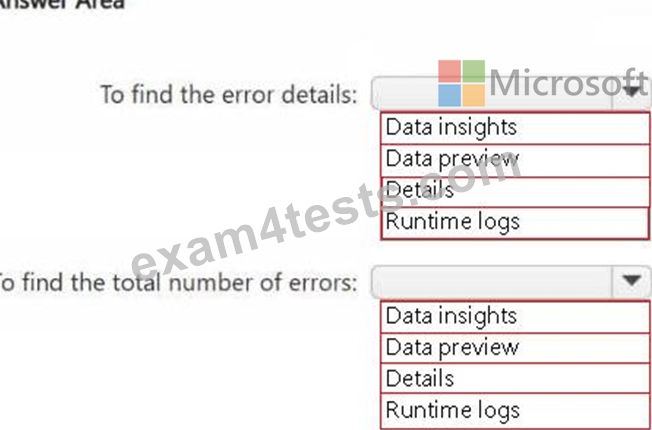
Answer:
Explanation: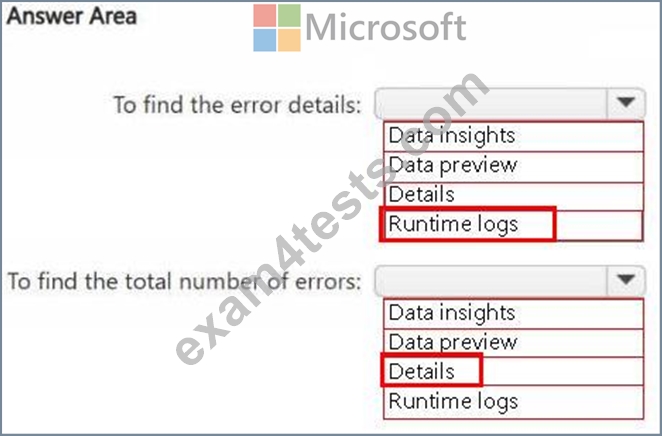
NEW QUESTION # 45
You have a Fabric workspace that contains a warehouse named Warehouse1.
You have an on-premises Microsoft SQL Server database named Database1 that is accessed by using an on-premises data gateway.
You need to copy data from Database1 to Warehouse1.
Which item should you use?
- A. a Dataflow Gen1 dataflow
- B. a data pipeline
- C. a KQL queryset
- D. a notebook
Answer: B
Explanation:
To copy data from an on-premises Microsoft SQL Server database (Database1) to a warehouse (Warehouse1) in Microsoft Fabric, the best option is to use a data pipeline. A data pipeline in Fabric allows for the orchestration of data movement, from source to destination, using connectors, transformations, and scheduled workflows. Since the data is being transferred from an on-premises database and requires the use of a data gateway, a data pipeline provides the appropriate framework to facilitate this data movement efficiently and reliably.
NEW QUESTION # 46
Note: This question is part of a series of questions that present the same scenario. Each question in the series contains a unique solution that might meet the stated goals. Some question sets might have more than one correct solution, while others might not have a correct solution.
After you answer a question in this section, you will NOT be able to return to it. As a result, these questions will not appear in the review screen.
You have a KQL database that contains two tables named Stream and Reference. Stream contains streaming data in the following format.
Reference contains reference data in the following format.
Both tables contain millions of rows.
You have the following KQL queryset.
You need to reduce how long it takes to run the KQL queryset.
Solution: You add the make_list() function to the output columns.
Does this meet the goal?
- A. No
- B. Yes
Answer: A
Explanation:
Adding an aggregation like make_list() would require additional processing and memory, which could make the query slower.
NEW QUESTION # 47
You have a Fabric workspace named Workspace1 that contains a notebook named Notebook1.
In Workspace1, you create a new notebook named Notebook2.
You need to ensure that you can attach Notebook2 to the same Apache Spark session as Notebook1.
What should you do?
- A. Enable high concurrency for notebooks.
- B. Change the runtime version.
- C. Enable dynamic allocation for the Spark pool.
- D. Increase the number of executors.
Answer: A
Explanation:
To ensure that Notebook2 can attach to the same Apache Spark session as Notebook1, you need to enable high concurrency for notebooks. High concurrency allows multiple notebooks to share a Spark session, enabling them to run within the same Spark context and thus share resources like cached data, session state, and compute capabilities. This is particularly useful when you need notebooks to run in sequence or together while leveraging shared resources.
NEW QUESTION # 48
You have an Azure Event Hubs data source that contains weather data.
You ingest the data from the data source by using an eventstream named Eventstream1. Eventstream1 uses a lakehouse as the destination.
You need to batch ingest only rows from the data source where the City attribute has a value of Kansas. The filter must be added before the destination. The solution must minimize development effort.
What should you use for the data processor and filtering? To answer, select the appropriate options in the answer area.
NOTE: Each correct selection is worth one point.
Answer:
Explanation:
NEW QUESTION # 49
You have a Fabric workspace that contains a lakehouse named Lakehouse1.
In an external data source, you have data files that are 500 GB each. A new file is added every day.
You need to ingest the data into Lakehouse1 without applying any transformations. The solution must meet the following requirements Trigger the process when a new file is added.
Provide the highest throughput.
Which type of item should you use to ingest the data?
- A. Event stream
- B. Data pipeline
- C. Streaming dataset
- D. Dataflow Gen2
Answer: A
Explanation:
To ingest large files (500 GB each) from an external data source into Lakehouse1 with high throughput and to trigger the process when a new file is added, an Eventstream is the best solution.
An Eventstream in Fabric is designed for handling real-time data streams and can efficiently ingest large files as soon as they are added to an external source. It is optimized for high throughput and can be configured to trigger upon detecting new files, allowing for fast and continuous ingestion of data with minimal delay.
NEW QUESTION # 50
You have a Fabric workspace named Workspace1 that contains a lakehouse named Lakehouse1. Lakehouse1 contains the following tables:
Orders
Customer
Employee
The Employee table contains Personally Identifiable Information (PII).
A data engineer is building a workflow that requires writing data to the Customer table, however, the user does NOT have the elevated permissions required to view the contents of the Employee table.
You need to ensure that the data engineer can write data to the Customer table without reading data from the Employee table.
Which three actions should you perform? Each correct answer presents part of the solution.
NOTE: Each correct selection is worth one point.
- A. Assign the data engineer the Viewer role for Workspace1.
- B. Assign the data engineer the Contributor role for Workspace1.
- C. Share Lakehouse1 with the data engineer.
- D. Create a new workspace named Workspace2 that contains a new lakehouse named Lakehouse2.
- E. Migrate the Employee table from Lakehouse1 to Lakehouse2.
- F. Assign the data engineer the Viewer role for Workspace2.
- G. Assign the data engineer the Contributor role for Workspace2.
Answer: B,C,E
Explanation:
To meet the requirements of ensuring that the data engineer can write data to the Customer table without reading data from the Employee table (which contains Personally Identifiable Information, or PII), you can implement the following steps:
Share Lakehouse1 with the data engineer.
By sharing Lakehouse1 with the data engineer, you provide the necessary access to the data within the lakehouse. However, this access should be controlled through roles and permissions, which will allow writing to the Customer table but prevent reading from the Employee table.
Assign the data engineer the Contributor role for Workspace1.
Assigning the Contributor role for Workspace1 grants the data engineer the ability to perform actions such as writing to tables (e.g., the Customer table) within the workspace. This role typically allows users to modify and manage data without necessarily granting them access to view all data (e.g., PII data in the Employee table).
Migrate the Employee table from Lakehouse1 to Lakehouse2.
To prevent the data engineer from accessing the Employee table (which contains PII), you can migrate the Employee table to a separate lakehouse (Lakehouse2) or workspace (Workspace2). This separation of sensitive data ensures that the data engineer's access is restricted to the Customer table in Lakehouse1, while the Employee table can be managed separately and protected under different access controls.
NEW QUESTION # 51
Note: This question is part of a series of questions that present the same scenario. Each question in the series contains a unique solution that might meet the stated goals. Some question sets might have more than one correct solution, while others might not have a correct solution.
After you answer a question in this section, you will NOT be able to return to it. As a result, these questions will not appear in the review screen.
You have a Fabric eventstream that loads data into a table named Bike_Location in a KQL database. The table contains the following columns:
You need to apply transformation and filter logic to prepare the data for consumption. The solution must return data for a neighbourhood named Sands End when No_Bikes is at least 15. The results must be ordered by No_Bikes in ascending order.
Solution: You use the following code segment:
Does this meet the goal?
- A. no
- B. Yes
Answer: A
Explanation:
This code does not meet the goal because it uses order by, which is not valid in KQL. The correct term in KQL is sort by.
Correct code should look like:
NEW QUESTION # 52
You are implementing the following data entities in a Fabric environment:
Entity1: Available in a lakehouse and contains data that will be used as a core organization entity Entity2: Available in a semantic model and contains data that meets organizational standards Entity3: Available in a Microsoft Power BI report and contains data that is ready for sharing and reuse Entity4: Available in a Power BI dashboard and contains approved data for executive-level decision making Your company requires that specific governance processes be implemented for the data.
You need to apply endorsement badges to the entities based on each entity's use case.
Which badge should you apply to each entity? To answer, drag the appropriate badges the correct entities. Each badge may be used once, more than once, or not at all. You may need to drag the split bar between panes or scroll to view content.
NOTE: Each correct selection is worth one point.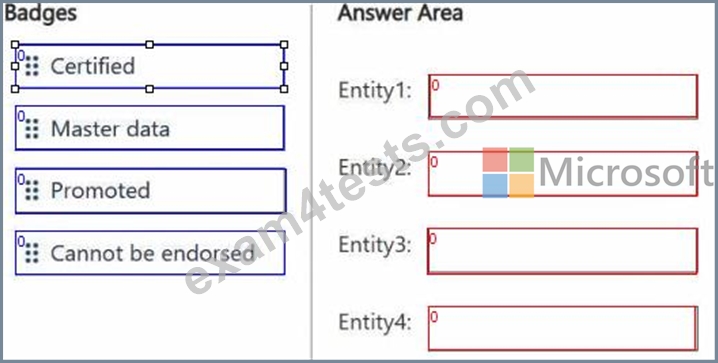
Answer:
Explanation: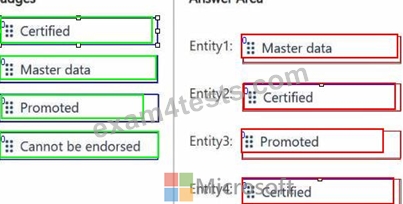
NEW QUESTION # 53
You need to populate the MAR1 data in the bronze layer.
Which two types of activities should you include in the pipeline? Each correct answer presents part of the solution.
NOTE: Each correct selection is worth one point.
- A. Copy data
- B. Stored procedure
- C. WebHook
- D. ForEach
Answer: A,D
Explanation:
MAR1 has seven entities, each accessible via a different API endpoint. A ForEach activity is required to iterate over these endpoints to fetch data from each one. It enables dynamic execution of API calls for each entity.
The Copy data activity is the primary mechanism to extract data from REST APIs and load it into the bronze layer in Delta format. It supports native connectors for REST APIs and Delta, minimizing development effort.
NEW QUESTION # 54
You have a Fabric capacity that contains a workspace named Workspace1. Workspace1 contains a lakehouse named Lakehouse1, a data pipeline, a notebook, and several Microsoft Power BI reports.
A user named User1 wants to use SQL to analyze the data in Lakehouse1.
You need to configure access for User1. The solution must meet the following requirements:
What should you do?
- A. Share Lakehouse1 with User1 directly and select Build reports on the default semantic model.
- B. Assign User1 the Viewer role for Workspace1. Share Lakehouse1 with User1 and select Read all SQL endpoint data.
- C. Share Lakehouse1 with User1 directly and select Read all SQL endpoint data.
- D. Assign User1 the Member role for Workspace1. Share Lakehouse1 with User1 and select Read all SQL endpoint data.
Answer: B
Explanation:
To meet the specified requirements for User1, the solution must ensure:
Read access to the table data in Lakehouse1: User1 needs permission to access the data within Lakehouse1. By sharing Lakehouse1 with User1 and selecting the Read all SQL endpoint data option, User1 will be able to query the data via SQL endpoints.
Prevent Apache Spark usage: By sharing the lakehouse directly and selecting the SQL endpoint data option, you specifically enable SQL-based access to the data, preventing User1 from using Apache Spark to query the data.
Prevent access to other items in Workspace1: Assigning User1 the Viewer role for Workspace1 ensures that User1 can only view the shared items (in this case, Lakehouse1), without accessing other resources such as notebooks, pipelines, or Power BI reports within Workspace1.
This approach provides the appropriate level of access while restricting User1 to only the required resources and preventing access to other workspace assets.
NEW QUESTION # 55
You have a Fabric workspace that contains a warehouse named Warehouse1. Warehouse1 contains the following tables and columns.
You need to denormalize the tables and include the ContractType and StartDate columns in the Employee table. The solution must meet the following requirements:
How should you complete the statement? To answer, select the appropriate options in the answer area.
NOTE: Each correct selection is worth one point.
Answer:
Explanation:
NEW QUESTION # 56
Note: This question is part of a series of questions that present the same scenario. Each question in the series contains a unique solution that might meet the stated goals. Some question sets might have more than one correct solution, while others might not have a correct solution.
After you answer a question in this section, you will NOT be able to return to it. As a result, these questions will not appear in the review screen.
You have a KQL database that contains two tables named Stream and Reference. Stream contains streaming data in the following format.
Reference contains reference data in the following format.
Both tables contain millions of rows.
You have the following KQL queryset.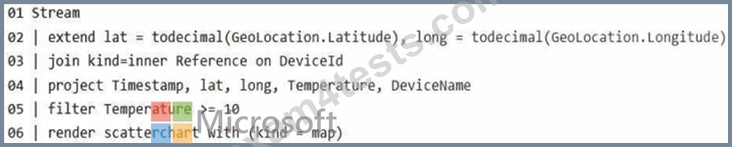
You need to reduce how long it takes to run the KQL queryset.
Solution: You change project to extend.
Does this meet the goal?
- A. No
- B. Yes
Answer: A
Explanation:
Using extend retains all columns in the table, potentially increasing the size of the output unnecessarily. project is more efficient because it selects only the required columns.
NEW QUESTION # 57
You have a Fabric workspace that contains an eventstream named EventStream1. EventStream1 outputs events to a table in a lakehouse.
You need to remove files that are older than seven days and are no longer in use.
Which command should you run?
- A. COMPUTE
- B. CLONE
- C. VACUUM
- D. OPTIMIZE
Answer: C
Explanation:
VACUUM is used to clean up storage by removing files no longer in use by a Delta table. It removes old and unreferenced files from Delta tables. For example, to remove files older than 7 days:
VACUUM delta.`/path_to_table` RETAIN 7 HOURS;
NEW QUESTION # 58
You have a Fabric workspace.
You are debugging a statement and discover the following issues:
You need to resolve the issues. The solution must ensure that the data types of the results are retained. The results can contain blank cells.
How should you complete the statement? To answer, select the appropriate options in the answer area.
NOTE: Each correct selection is worth one point.
Answer:
Explanation:
NEW QUESTION # 59
You have a Fabric workspace named Workspace1 that contains an Apache Spark job definition named Job1.
You have an Azure SQL database named Source1 that has public internet access disabled.
You need to ensure that Job1 can access the data in Source1.
What should you create?
- A. an integration runtime
- B. a managed private endpoint
- C. an on-premises data gateway
- D. a data management gateway
Answer: B
Explanation:
To allow Job1 in Workspace1 to access an Azure SQL database (Source1) with public internet access disabled, you need to create a managed private endpoint. A managed private endpoint is a secure, private connection that enables services like Fabric (or other Azure services) to access resources such as databases, storage accounts, or other services within a virtual network (VNet) without requiring public internet access. This approach maintains the security and integrity of your data while enabling access to the Azure SQL database.
NEW QUESTION # 60
You need to create the product dimension.
How should you complete the Apache Spark SQL code? To answer, select the appropriate options in the answer area.
NOTE: Each correct selection is worth one point.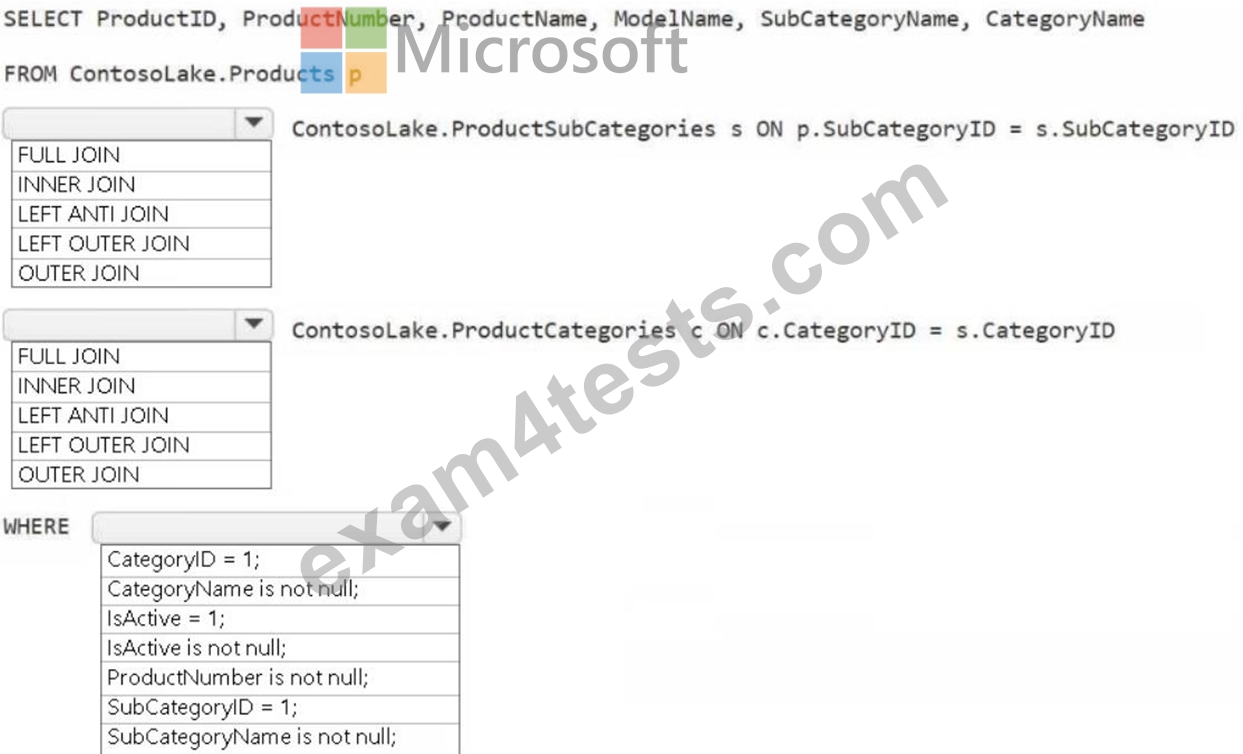
Answer:
Explanation:
NEW QUESTION # 61
You have an Azure Data Lake Storage Gen2 account named storage1 and an Amazon S3 bucket named storage2.
You have the Delta Parquet files shown in the following table.
You have a Fabric workspace named Workspace1 that has the cache for shortcuts enabled. Workspace1 contains a lakehouse named Lakehouse1. Lakehouse1 has the following shortcuts:
The data from which shortcuts will be retrieved from the cache?
- A. Stores only
- B. Products and Store only
- C. Trips and Stores only
- D. Products only
- E. Products. Stores, and Trips
Answer: B
Explanation:
When the cache for shortcuts is enabled in Fabric, the data retrieval is governed by the caching behavior, which generally retains data for a specific period after it was last accessed. The data from the shortcuts will be retrieved from the cache if the data is stored in locations that support caching. Here's a breakdown based on the data's location:
Products: The ProductFile is stored in Azure Data Lake Storage Gen2 (storage1). Since Azure Data Lake is a supported storage system in Fabric and the file is relatively small (50 MB), this data is most likely cached and can be retrieved from the cache.
Stores: The StoreFile is stored in Amazon S3 (storage2), and even though it is stored in a different cloud provider, Fabric can cache data from Amazon S3 if caching is enabled. This data (25 MB) is likely cached and retrievable.
Trips: The TripsFile is stored in Amazon S3 (storage2) and is significantly larger (2 GB) compared to the other files. While Fabric can cache data from Amazon S3, the larger size of the file (2 GB) may exceed typical cache sizes or retention windows, causing this file to likely be retrieved directly from the source instead of the cache.
NEW QUESTION # 62
You need to troubleshoot the ad-hoc query issue.
How should you complete the statement? To answer, select the appropriate options in the answer area.
NOTE: Each correct selection is worth one point.
Answer:
Explanation:
NEW QUESTION # 63
......
DP-700 dumps review - Professional Quiz Study Materials: https://braindumps.exam4tests.com/DP-700-pdf-braindumps.html