

Validate your Skills with Updated 1Z0-082 Exam Questions & Answers and Test Engine
Tested & Approved 1Z0-082 Study Materials Download Free Updated 145 Questions
Oracle 1Z1-082 exam is an essential certification for all professionals who work in Oracle Database Administration I. This is a popular exam taken by professionals who are responsible for database administration and management. If you're looking to demonstrate your understanding of database administration and gain recognition in the industry, then passing the Oracle 1Z1-082 exam is the way to go.
The 1Z1-082 exam covers various topics such as database architecture, installation and configuration, backup and recovery, security, and performance tuning. Candidates are required to demonstrate their ability to manage and maintain Oracle databases efficiently and effectively, ensuring the reliability, availability, and scalability of the database.
NEW QUESTION # 26
Which three Oracle database space management features will work with both Dictionary and Locally managed tablespaces? (Choose three.)
- A. Oracle Managed Files (OMF)
- B. Automatic data file extension (AUTOEXTEND)
- C. Online index segment shrink
- D. Online table segment shrink
- E. Capacity planning growth reports based on historical data in the Automatic Workload Repository (AWR)
Answer: A,B,E
NEW QUESTION # 27
Which two can you use to recover a dropped table? (Choose two.)
- A. FLASHBACK QUERY
- B. FLASHBACK TABLE TO SCN
- C. FLASHBACK DATABASE
- D. FLASHBACK TRANSACTION
- E. FLASHBACK DROP
Answer: B,E
NEW QUESTION # 28
Which two statements are true about undo and undo tablespaces?
- A. An undo tablespace may be owned by only one instance.
- B. An instance will crash if the active undo tablespace is lost.
- C. There can be only one undo tablespace created in a database.
- D. undo segments are owned by SYSTEM.
- E. undo segments are owned by SYSBACKUP.
Answer: A,B
NEW QUESTION # 29
Which three activities are recorded in the database alert log? (Choose three.)
- A. block corruption errors
- B. Data Definition Language (DDL) statements
- C. session logins and logouts
- D. non-default database parameters
- E. deadlock errors
Answer: A,D,E
Explanation:
https://docs.oracle.com/cd/B28359_01/server.111/b28310/monitoring001.htm#ADMIN11247
NEW QUESTION # 30
Which two are true about a SQL statement using SET operators such as UNION? (Choose two.)
- A. The data type of each column returned by the second query must be implicitly convertible to the data type of the corresponding column returned by the first query.
- B. The data type of each column returned by the second query must exactly match the data type of the corresponding column returned by the first query.
- C. The data type group of each column returned by the second query must match the data type of the corresponding column returned by the first query.
- D. The names and number of columns must be identical for all SELECT statements in the query.
- E. The number, but not names, of columns must be identical for all SELECT statements in the query.
Answer: B,C
NEW QUESTION # 31
View the Exhibits and examine the structure of the COSTS and PROMOTIONS tables.
You want to display PROD_IDS whose promotion cost is less than the highest cost PROD_ID in a promotion time interval.
Examine this SQL statement:
Exhibit 1.
Exhibit 2.
What will be the result?
- A. It executes successfully but does not give the required result
- B. It executes successfully and gives the required result
- C. It gives an error because the GROUP BY clause is not valid
- D. It gives an error because the ALL keyword is not valid
Answer: B
NEW QUESTION # 32
Which two statements are true about the Automatic Diagnostic Repository (ADR)? (Choose two.)
- A. It is held inside an Oracle database schema
- B. The ADR base defaults to $ORACLE_HOME/dbs if the DIAGNOSTIC_DEST parameter and the ORACLE_BASE environment variable are not set
- C. It supports diagnostics for Automatic Storage Management (ASM)
- D. The ADR base defaults to $ORACLE_HOME/rdbms/admin ifneither DIAGNOSTIC_DEST nor ORACLE_BASE is set
- E. It supports diagnostics for Oracle Clusterware
Answer: A,D
NEW QUESTION # 33
You need to calculate the number of days from 1st January 2019 until today.
Dates are stored in the default format of DD-MON-RR.
Which two queries give the required output? (Choose two.)
- A. SELECT ROUND(SYSDATE - TO_DATE('01/JANUARY/2019')) FROM DUAL;
- B. SELECT ROUND(SYSDATE - '01-JAN-2019') FROM DUAL;
- C. SELECT TO_DATE(SYSDATE, 'DD/MONTH/YYYY') - '01/JANUARY/2019' FROM DUAL;
- D. SELECT TO_CHAR(SYSDATE,'DD-MON-YYYY') - '01-JAN-2019' FROM DUAL;
- E. SELECT SYSDATE - TO_DATE('01-JANUARY-2019') FROM DUAL;
Answer: A,E
NEW QUESTION # 34
Examine the description of the CUSTOMERS table: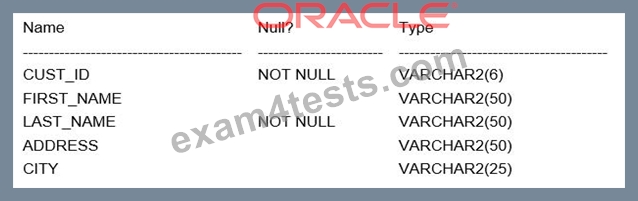
You want to display details of all customers who reside in cities starting with the letter D followed by at least two characters.
Which query can be used?
- A. SELECT * FROM customers WHERE city = '%D_';
- B. SELECT * FROM customers WHERE city LIKE 'D_';
- C. SELECT * FROM customers WHERE city LIKE 'D_%';
- D. SELECT * FROM customers WHERE city = 'D_%';
Answer: C
NEW QUESTION # 35
The ORCL database has RESUMABLE__TIMEOUT = 7200 and DEFERRED_SEGMENT_CREATION = FALSE User U1 has a 1 MB quota in tablespace DATA.
U1 executes this command:
SQL> CREATE TABLE t1 AS
(SELECT object_name, sharing, created
FROM dba_objects);
U1 complains that the command is taking too long to execute.
In the alert log, the database administrator (DBA) finds this:
2017-03-06T12:15:17.183438+05:30
statement in resumable session 'User U1(136), Session 1, Instance 1' was suspended due to ORA-01536: space quota exceeded for tablespace 'DATA' Which are three actions any one of which the DBA could take to resume the session? (Choose three.)
- A. Increase U1's quota sufficiently in DATA
- B. Drop other U1 objects in DATA
- C. Set AUTOEXTEND ON for data files in DATA
- D. Grant UNLIMITED TABLESPACE to U1
- E. Add a data file to DATA
- F. Set DEFERRED_SEGMENT_CREATION to TRUE
Answer: A,C,F
NEW QUESTION # 36
Which two statements are true about the WHERE and HAVING clauses in a SELECT statement?
(Choose two.)
- A. The WHERE clause can be used to exclude rows after dividing them into groups
- B. The WHERE clause can be used to exclude rows before dividing them into groups
- C. Aggregating functions and columns used in HAVING clauses must be specified in the SELECT list of a query
- D. WHERE and HAVING clauses can be used in the same statement only if applied to different table columns
- E. The HAVING clause can be used with aggregating functions in subqueries
Answer: B,E
NEW QUESTION # 37
Which three statements are true about advanced connection options supported by Oracle Net for connection to Oracle Database instances? (Choose three.)
- A. Connect Time Failover requires the connect string to have two or more listener addresses configured
- B. Source Routing enables the use of Connection Manager (CMAN) which enables network traffic to be routed through a firewall
- C. Load Balancing requires the use of a name server
- D. Source Routing requires the use of a name server
- E. Load Balancing can balance the number of connections to dispatchers when using a Shared Server configuration
- F. Connect Time Failover requires the use of Transparent Application Failover (TAF)
Answer: A,B,D
NEW QUESTION # 38
Examine the description of the CUSTOMERS table:
For customers whose income level has a value, you want to display the first name and due amount as 5% of their credit limit. Customers whose due amount is null should not be displayed.
Which query should be used?
- A. SELECT cust_first_name, cust_credit_limit * .05 AS DUE_AMOUNTFROM customersWHERE cust_income_level != NULLAND cust_credit_level !=NULL;
- B. SELECT cust_first_name, cust_credit_limit * .05 AS DUE_AMOUNTFROM customersWHERE cust_income_level IS NOT NULLAND due_amount IS NOT NULL;
- C. SELECT cust_first_name, cust_credit_limit * .05 AS DUE_AMOUNTFROM customersWHERE cust_income_level != NULLAND due_amount != NULL;
- D. SELECT cust_first_name, cust_credit_limit * .05 AS DUE_AMOUNTFROM customersWHERE cust_income_level IS NOT NULLAND cust_credit_limit IS NOT NULL;
- E. SELECT cust_first_name, cust_credit_limit * .05 AS DUE_AMOUNTFROM customersWHERE cust_income_level <> NULLAND due_amount <> NULL;
Answer: D
NEW QUESTION # 39
In the ORCL database, UNDOTBS1 is the active undo tablespace with these properties:
1. A size of 100 MB
2. AUTOEXTEND is off
3. UNDO_RETENTION is set to 15 minutes
4. It has RETENTION GUARANTEE
UNDOTBS1 fills with uncommitted undo 10 minutes after the database opens.
What will happen when the next update is attempted by any transaction?
- A. It succeeds and the least recently written undo block of UNDOTBS1 is overwritten by the generated undo.
- B. It succeeds and the generated undo is stored in SYSTEM.
- C. It succeeds and the generated undo is stored in SYSAUX.
- D. It succeeds and the least recently read undo block of UNDOTBS1 is overwritten by the generated undo.
- E. It fails and returns the error message "ORA-30036: unable to extend segment by 8 in undo tablespace
'UNDOTBS1'".
Answer: A
NEW QUESTION # 40
Which three statements are true about undo segments and the use of undo by transactions in an Oracle database instance? (Choose three.)
- A. Undo segments must be stored in a BIGFILE tablespace
- B. An undo segment may be used by multiple transactions simultaneously
- C. Undo segments can wrap around to the first extent when a transaction fills the last extend of the undo segment
- D. A single transaction may use multiple undo segments simultaneously
- E. Undo segments must be stored in a SMALLFILE tablespace
- F. Undo segments have a minimum of three extents
- G. Undo segments can extend when a transaction fills the last extent of the undo segment
Answer: B,E,G
NEW QUESTION # 41
Which two statements are true about the PMON background process? (Choose two.)
- A. It registers database services with all local and remote listeners known to the database instance
- B. It frees resources held by abnormally terminated processes
- C. It kills sessions that exceed idle time
- D. It records checkpoint information in the control file
- E. It frees unused temporary segments
Answer: A,B
Explanation:
https://docs.oracle.com/cd/B19306_01/server.102/b14220/process.htm
NEW QUESTION # 42
The SALES_Q1 and USERS tablespaces exist in one of your databases and TEMP is a temporary tablespace.
Segment creation is not deferred.
You execute this command: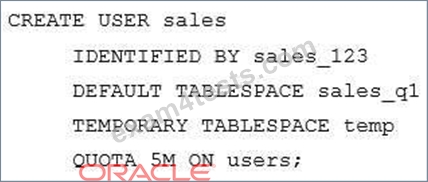
Which three statements must be true so that the SALES user can create tables in SALES_Q1? (Choose three.)
- A. The sales user must have a quota on the SALES_Q1 tablespace to hold the initial extends of all tables they plan to create in their schema
- B. The sales user must have been granted the CREATE TABLE privilege
- C. The sales user must have been granted the CREATE SESSION privilege
- D. The sales user must have their quota on the users tablespace removed
- E. The sales user must have a quota on the TEMP tablespace
- F. The sales user must have a quota on the SALES_Q1 tablespace to hold all the rows to be inserted into any table in their schema
Answer: A,B,D
NEW QUESTION # 43
Your database instance is started with an SPFILE.
A PFILE is also available. You execute this command:
ALTER SYSTEM SET DB_CACHE_SIZE=100K;
Where Is the value changed?
- A. in the SPFILE and SPFILEc
- B. in the SPFILE, SPFILE, and memory
- C. in the SPFILE and in memory
- D. only in memory
- E. only In the SPFILE
Answer: A
NEW QUESTION # 44
Which two statements are true about the PMON background process? (Choose two.)
- A. It registers database services with all local and remote listeners known to the database instance
- B. It frees resources held by abnormally terminated processes
- C. It kills sessions that exceed idle time
- D. It records checkpoint information in the control file
- E. It frees unused temporary segments
Answer: A,B
NEW QUESTION # 45
Examine the description of the CUSTOMERS table:
For customers whose income level has a value, you want to display the first name and due amount as 5% of their credit limit. Customers whose due amount is null should not be displayed.
Which query should be used?
- A. SELECT cust_first_name, cust_credit_limit * .05 AS DUE_AMOUNT
FROM customers
WHERE cust_incoms_level IS NOT NULL
AND due_amount IS NOT NULL; - B. SELECT cust_first_name, cust_credit_limit * .05 AS DUE_AMOUNT
FROM customers
WHERE cust_income_level IS NOT NULL
AND cust_credit_limit IS NOT NULL; - C. SELECT cust_first_name, cust_credit_limit * .05 AS DUE_AMOUNT
FROM customers
WHERE cust_income_level <> NULL
AND due_amount <> NULL; - D. SELECT cust_first_name, cust_credit_limit * .05 AS DUE_AMOUNT
FROM customers
WHERE cust_income_level != NULL
AND cust_credit_level !=NULL; - E. SELECT cust_first_name, cust_credit_limit * .05 AS DUE_AMOUNT
FROM customers
WHERE cust_income_level != NULL
AND due_amount !=NULL;
Answer: B
NEW QUESTION # 46
You need to calculate the number of days from 1st January 2019 until today.
Dates are stored in the default format of DD-MON-RR.
Which two queries give the required output? (Choose two.)
- A. SELECT ROUND(SYSDATE - '01-JAN-2019') FROM DUAL;
- B. SELECT ROUND(SYSDATE - TO_DATE('01/JANUARY/2019')) FROM DUAL;
- C. SELECT TO_DATE(SYSDATE, 'DD/MONTH/YYYY') - '01/JANUARY/2019' FROM DUAL;
- D. SELECT TO_CHAR(SYSDATE, 'DD-MON-YYYY') - '01-JAN-2019' FROM DUAL;
- E. SELECT SYSDATE - TO_DATE('01-JANUARY-2019') FROM DUAL;
Answer: A,D
NEW QUESTION # 47
......
Oracle 1Z1-082 certification is a valuable certification for individuals who are seeking to become database administrators. Oracle Database Administration I certification is recognized worldwide and is highly valued in the industry. Oracle Database Administration I certification demonstrates the candidate's ability to manage and maintain an Oracle database environment effectively. Oracle Database Administration I certification also opens up various job opportunities for the candidate, including positions in database administration, database development, and database consulting.
Regular Free Updates 1Z0-082 Dumps Real Exam Questions Test Engine: https://braindumps.exam4tests.com/1Z0-082-pdf-braindumps.html